This article provides the decision framework for that moment. Confirm the injectors are genuinely the constraint, then work through the options with a clear view of what each one costs you in time, money, and rework. The aim isn't to reach for the loudest answer. It's to match the fix to the actual problem.
First, make sure the limit is real
Before you change anything, confirm that the injectors are actually what's holding you back. Duty cycle data makes that harder than it sounds because, a lot of the time, the number on your screen is a calculated, commanded figure, rather than a true measurement of the injector itself. It's the pulse width the ECU is asking for, expressed against the time available in the engine cycle. Whether the calculation includes injector dead time varies between ECUs and loggers as well, so the same operating point can read differently on two platforms. The number is a useful gauge, but it isn't ground truth.
This is also why you'll sometimes see a figure beyond 100%. An injector can't open for longer than the engine cycle itself, so 100% is its natural ceiling where it's held open continuously. A logged 110% or 120% isn't the injector doing the impossible, it's the calculation reporting demand the cycle has no room for. So treat anything at or above 100% as the system telling you it's run out of time. Our job is to find out why.
A few things can drive that number up without the injector being the real constraint. A common one is fuel pressure falling away under increasing flow demands. If the pump can't keep up, or the lines or filter become a restriction when demand is high, pressure drops and the injector flows less for every millisecond it's open, so the ECU commands more on-time to hit target and the duty cycle climbs. That's the supply feeding the injector, not the injector itself. Since flow is set by the differential pressure across the injector, not rail pressure on its own, log fuel pressure under load, referenced to manifold pressure, and confirm it holds where the duty cycle peaks. The Fuel Pressure vs Flow Calculator shows how much flow you give up when that differential drops.
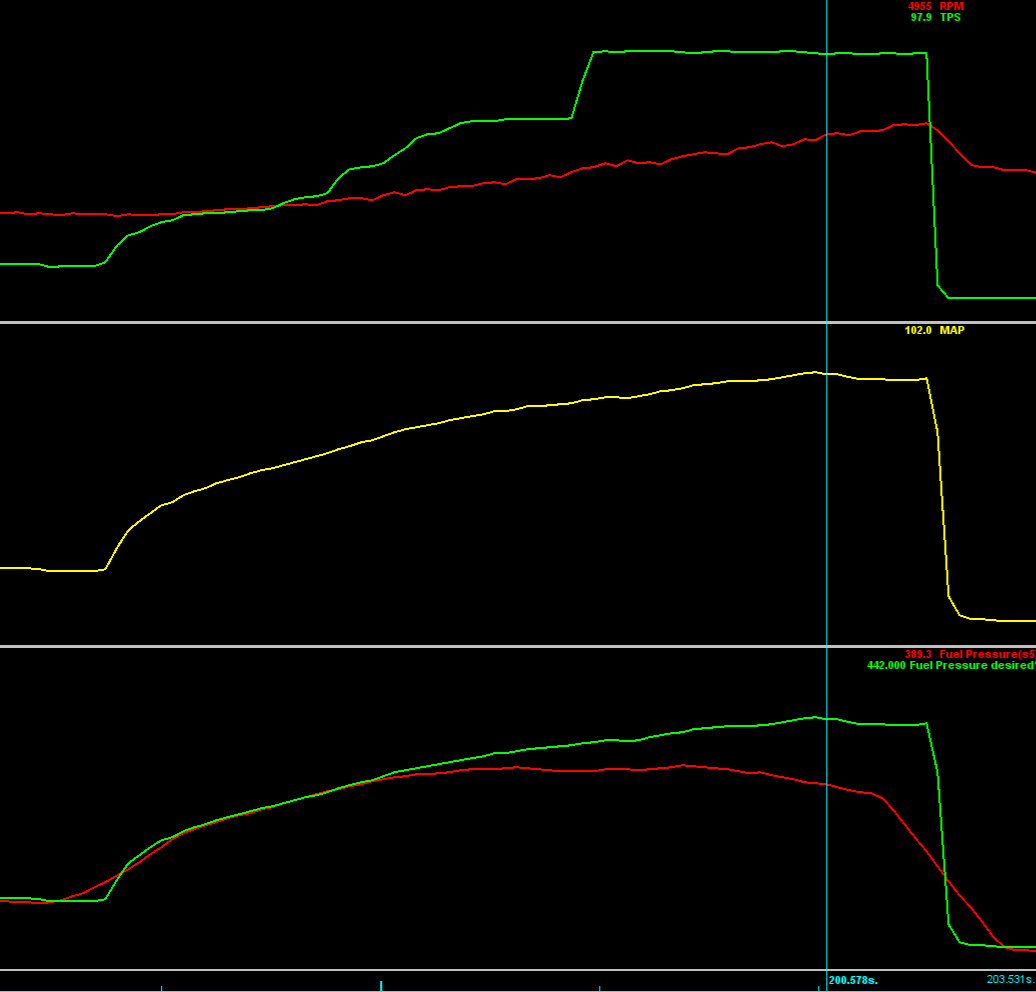
Poor injector characterisation does the same thing. If the flow data or dead time is wrong, the commanded pulse width is wrong, and the reading inherits that error. And a brief spike on a fast transient isn't a sustained value at steady-state, wide open throttle, so make sure you're reading a settled point, not a momentary artefact.
Now, the most reliable confirmation isn't in the duty cycle number at all. It's in the lambda trace. Injector flow stays close to linear through most of its range, roughly 20 to 85% duty cycle, which is why our sizing targets sit in that band. Past that, as the injector approaches continuous operation, the slice of each cycle it spends opening and closing shrinks. Think about what the needle in the injector is doing right before it starts to transition into the non-linear region. The commanded on-time includes the time taken to move the needle off the seat, before we see any fuel flow. The injector will then take a small period of time to close before being triggered again by the ECU. When we start commanding injector on-times approaching available cycle time the injector doesn't fully close before it is asked to open again, so the time it spends opening and closing with no associated flow diminishes. This means the injector delivers a little more fuel per cycle than the linear model expects because it never fully closed but the next cycle includes dead time that is no longer applicable, and this shows up as the mixture drifting rich. So, an uncommanded creep towards rich, right at the top of a pull with nothing changed in the tune, is an early sign the injector is entering its non-linear region and running out of room. Keep pushing, and once it's genuinely static with airflow still climbing, there's nothing left to add and the mixture swings lean. Rich first, then lean. Some injectors float near the limit and lean out earlier instead, but either way it's lambda diverging from the calibrated target at the top of the pull, not the duty cycle figure, that tells you what's going on. Chasing this by trying to adjust your VE table will just lead to swings in lambda and inconsistent results. The distinction matters. Swings only at the very top are the injector, whereas a consistent rich offset across the range is the airflow model, and that's the one you can fix.
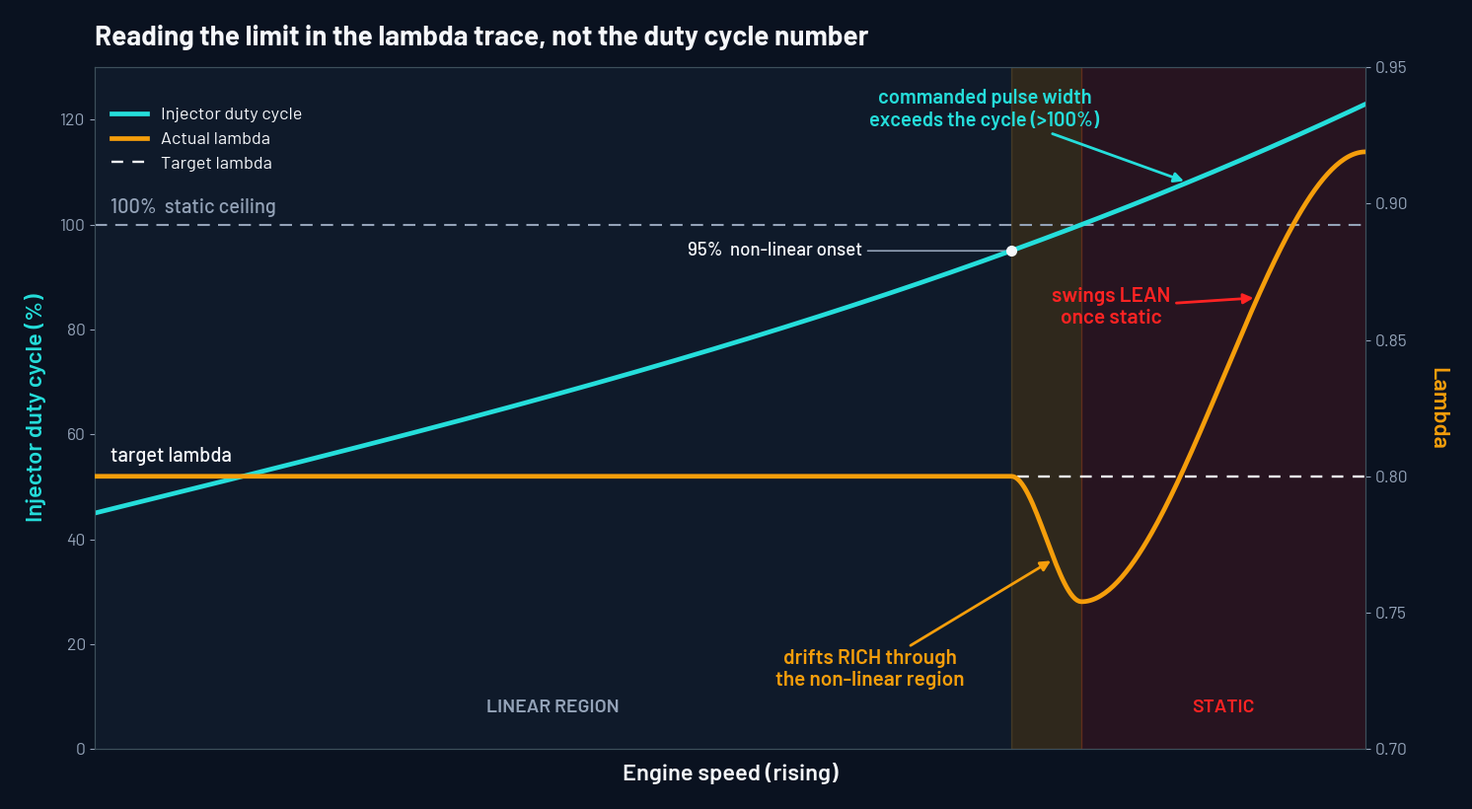
Remember, a duty cycle reading is commanded pulse width, not a measurement. Confirm it's the injector that's run out of room, and not the system feeding it.
Then make sure the calibration isn't overfuelling
Here's the part that often gets missed. An injector that's maxed out doesn't mean the engine needs all that fuel. Remember, the duty cycle is commanded pulse width, so anything that inflates the command inflates the reading along with it, and a calibration asking for more fuel than the engine needs will pin the injector earlier than it should. This check tends to get skipped, because an IDC number points straight at the injector and the hardware feels like the obvious answer. It's also, more often than not, where the cheapest fix is hiding.
The first thing to get right is the airflow model. If it isn't dialled in, that's always where you start. The tell is target against actual lambda. Running open loop, which is most setups once you're up at high load, the ECU commands a pulse width to hit target from its own estimate of the airflow going in. With an accurate model, lambda should track target, the same as on any normal calibration. If it's swinging around instead, as we covered earlier, that's the first sign of the injector running in its non-linear region, and no amount of airflow work will fix it. But if actual sits consistently richer than target, the airflow estimate is reading high, or miscalibrated compensations are creeping in and stacking fuel on top. On a speed-density setup our airflow estimate is essentially the VE table, and on a MAF-based setup it's the MAF transfer function. And in the closed-loop areas, a short-term or long-term fuel trim sitting well negative, pulling fuel back out to hold target, tells you the same story about the base airflow model.
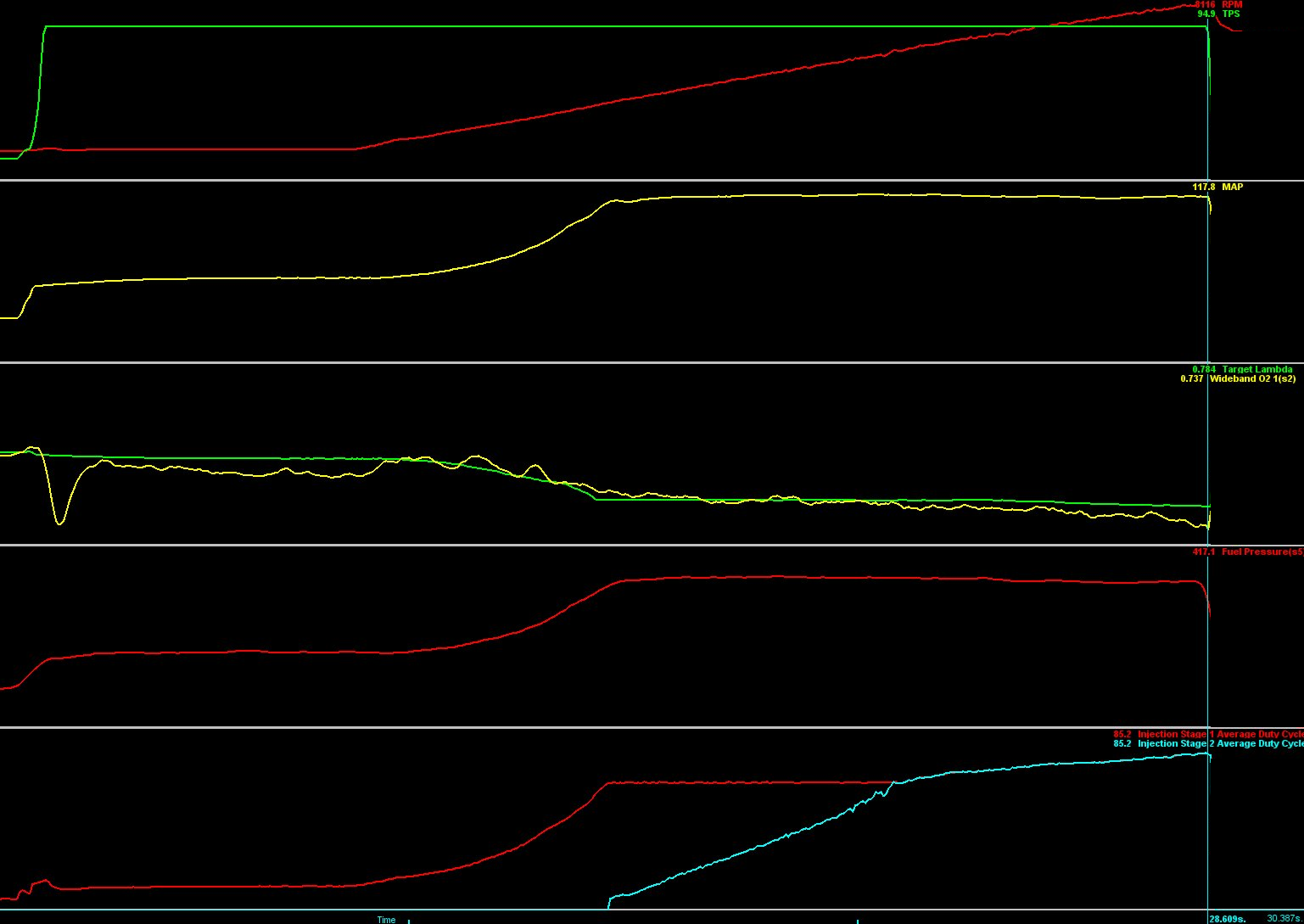
Let's talk about compensations a bit more. Charge temperature, engine temperature, and voltage correction can each change commanded pulse width, and transient or acceleration enrichment shouldn't be doing much at a settled, wide open throttle point. So if they're adding meaningful fuel up there, something isn't calibrated right, and a model already reading high, with compensations piled on top, can easily end up commanding 10% or more fuel than the engine actually needs. Again, standard calibration procedures should be used to validate your compensation tables are in line with what the engine needs.
The target lambda itself is worth a separate look. This one isn't a model error, it's a choice. A target set richer than the conditions call for injects excess fuel mass, and duty cycle climbs with it. Leaning it back depends on having the knock margin to spare, the same trade-off we'll get to below, so it's a deliberate decision, not free headroom. Even so, it's worth knowing whether the target is part of the reason why the injector is maxed out. Running lambda targets into the low 0.70 region is seldom the right target for gasoline and ethanol blends, and a reasonable amount of injector headroom (and duty cycle) can be recovered by setting more appropriate lambda targets in the wide-open-throttle areas of the map.
Once you get the commanded fuel requirement back to where it should be, a decent chunk of duty cycle often comes straight back, no hardware involved. Do that alongside a small bump in base fuel pressure, and that's often the whole fix. The injector reading was only ever the symptom. The calibration was the cause.
An IDC limit points straight at the injector, but the cause is often in the tune. Get the commanded fuel honest before you spend a cent on hardware.
What the headroom was protecting
Sizing injectors to sit around 85 to 90% duty cycle, rather than right up at 100%, isn't superstition, and the reasoning behind injector sizing covers why we leave that gap on purpose. The short version is that the headroom is working room. Injector dead time eats into every pulse. Transient enrichment, and charge and engine temperature compensation, all add pulse width on top of the steady-state demand, and hot fuel and low battery voltage stretch it further again. Right at the limit there's no room left for the fuel those compensations still need to deliver, which is why the mixture goes unstable rather than just flattening off.
So being at the limit means more than just no extra peak power. It means the calibration has lost its margin to respond to changing conditions, and that's the real cost. It's worth a quick check with the Injector Sizing Calculator to see how much capacity the setup genuinely has before you decide which way to go.
Raise the fuel pressure
This is the quickest lever, and the one most people reach for first. Raising rail pressure raises the differential pressure across the injector, which raises flow. The catch is that flow scales with the square root of the pressure ratio, so the gain is limited. Doubling the differential buys around 40% more flow, not double, and the returns fall away quickly from there. The Fuel Pressure vs Flow Calculator lays out that curve.
The real trap here though is the pump. The injector only flows its higher number if the pump can hold that higher pressure while still supplying the flow. If the pump is already near its own limit, winding up the regulator setpoint just shifts the bottleneck from the injector to the pump, and you've gained nothing. So confirm the pump can deliver the flow you need at the new pressure before you count on it. Higher pressure also shifts injector behaviour, because both the dead time and the minimum reliable pulse width change, so the dead time data needs another look, or the idle and low-load fuelling will drift.
Raising fuel pressure only helps if the pump can hold that higher pressure under flow. Otherwise you've just moved the bottleneck, not removed it.
Fit larger injectors
This is the direct fix. A larger injector delivers the same fuel mass in less on-time, so the duty cycle at your operating point drops and the headroom comes back. If you genuinely need more capacity, this is the honest answer.
The cost lands at the other end of the range. Larger injectors have a longer minimum pulse width and poorer low-pulse linearity, so idle and light-load fuelling get harder to control and can turn unstable if the low-pulse data isn't up to scratch. Fitting larger injectors means a full re-characterisation of the dead time, the flow curve, and that all-important low-pulse region, then re-verifying the fuel model. It's the clean fix, but can also be quite involved.
Bigger injectors fix the top of the range, but they can cost you the bottom. The low-pulse-width region is where that trade-off shows up.
Lower the ethanol content
This is the option people reach for least, and the one that runs against instinct. The fuel itself sets how much mass we need to make a given amount of power. A high-ethanol blend like E85 demands roughly 50% more fuel mass than gasoline for the same amount of air, which is why an engine that's comfortable on pump gas can end up maxed on E85 at the same output.
So if you're already on a high-ethanol blend and out of injector, lowering the ethanol content brings that mass demand down and recovers duty cycle headroom directly. Drop from E85 to a lower blend, or back to gasoline, and the injectors have room again.
Of course, it isn't free. That ethanol was buying you knock margin, and the timing or boost that margin allowed. Give up the ethanol and you give up some of that, so this is a straight trade of fuel-system headroom against knock margin, the exact inverse of why most people move to ethanol in the first place. It's worth weighing up for when the duty cycle limit, not knock, is holding the engine back. Remember though, that even at E50 you still have excellent charge cooling and knock resistance gains. This is an especially useful lever for direct injected engines where aftermarket injector support is limited or non-existent, and you simply have to look at other methods to lower the injector duty cycle.
More ethanol buys you knock margin, but it spends duty cycle to do it. If the injector is the limit and knock isn't, a lower blend buys that room back.
Add staged injection
When a single set of injectors can't cover both a stable idle and the top-end demand, a second, staged set can be the way out. Small primaries keep idle and light load crisp and on point, while larger secondaries stage in at higher load and RPM, splitting the fuel delivery duties across more injectors, so no single one is left maxed out.
It is, however, also the most involved. The ECU has to support staged injection, and the switchover and blending between the two sets is a calibration task of its own, on top of the extra hardware and plumbing. All of that puts staged injection firmly into advanced-control territory, so treat it as the path you take once the simpler options have genuinely run out. It's not a first move.
Reduce the power target
This is the option nobody seems to offer up on a forum, and yet it's equally as valid. If the fuel system was scoped for a particular power level and the goal has since crept well past it, the cheapest and most reliable fix is to simply accept the power the system can support. A fuel system honestly sized for 400 horsepower doesn't owe you 550. Backing the target down to where the injectors sit at a sensible duty cycle costs nothing, takes the risk off the table, and is often the most sensible call once the numbers are in front of you.
Choosing between them
None of these is the right answer on its own. The right one depends on the constraint you're dealing with, and that usually comes down to a handful of answers to carefully thought out questions. Does the injector even need to be maxed? Is the calibration commanding more fuel than the engine needs? Is the pump holding pressure, or is it already the weak link? How far past the limit are you, a few percent or a long way over? Does idle quality matter for this build, or is it a dedicated, high-load race car? What's the budget and the appetite for re-tuning? And is the engine flex-capable, with the injector rather than knock stopping you? Thinking through the use case, what the data is telling you, and keeping your expectations in check, will have you back in action and with a clear path forward.
With that in mind, the right choice often makes itself.
| Option | Cost | Rework | Best when |
|---|---|---|---|
| Correct the calibration | None to low | Re-validate the fuel model | Always check first, before any hardware |
| Raise fuel pressure | Low | Re-check dead time | The pump has headroom and you need a few percent |
| Fit larger injectors | Medium | Full re-characterisation | You need real capacity and can re-tune the idle |
| Lower the ethanol content | Low | Re-tune for the blend | Flex-capable, with the injector not knock as the limit |
| Add staged injection | High | Major, advanced control | High demand with a stable idle still required |
| Reduce the power target | None | Minimal | The system was honestly scoped and the goal crept |
Key points
- Duty cycle is a calculated, commanded figure rather than a true measurement, and whether it includes dead time will vary by ECU and logger. A reading at or above 100% is just the calculation reporting demand the cycle has no room for, not the injector exceeding its ceiling.
- Always confirm the limit is real before you act on it. Rule out fuel pressure dropping under load, a bad injector characterisation, and any transient spikes first, then read the lambda trace.
- Lambda is a better tell than the number itself. The mixture drifts rich as the injector enters its non-linear region near 100%, then swings lean once it's gone static and the airflow keeps climbing. Swings and inconsistency only at the very top are the injector, not something to chase in the VE table.
- A maxed injector doesn't always mean the engine needs the fuel, so always start with the airflow model. Running open loop, an actual lambda consistently richer than target means the ECU is overfuelling, from a VE table or MAF transfer function reading high, or compensations stacking on top. In the closed-loop regions, a short-term or long-term fuel trim sitting well negative says the same thing.
- Correcting the fuel model, and re-checking the target lambda and compensations, can recover 10% or more of your duty cycle with no hardware change, often with just a small base fuel pressure bump alongside. The injector reading is the symptom, the calibration is frequently the cause.
- Aim to keep your duty cycle around 80 to 90%, and out of that non-linear region. That headroom is working room for dead time, enrichment, and compensations, not wasted capacity.
- Raising fuel pressure is bounded by that square-root relationship, and only helps if the pump can hold the pressure under flow.
- Larger injectors restore the top-end headroom, but can cost you low-pulse-width control at idle, and need a full re-characterisation to do properly.
- On a flex-capable engine, lowering the ethanol content reduces the fuel mass demand and recovers headroom, traded against your knock margin.
- Staged injection is the most capable option, and also the most involved. Reducing the power target costs nothing, and is often the most honest fix.
Related Resources
Calls like this come up constantly in calibration, and rarely as cleanly as a single maxed injector. Building the judgment to read what the data is actually telling you, across the whole calibration and under real-world conditions, is what Stage 5 of the Calibration Competence and EFI Master Programs is built to develop, through a structured progression with depth that carries over to engines and problems you haven't seen before. If you're not sure which one fits your goals, do the free assessment and it'll point you in the right direction.
Find Your ProgramGet notified of new articles
One article per week on EFI fundamentals, calibration principles, and diagnostic thinking. No spam.
You're subscribed. We'll let you know when new articles are published.