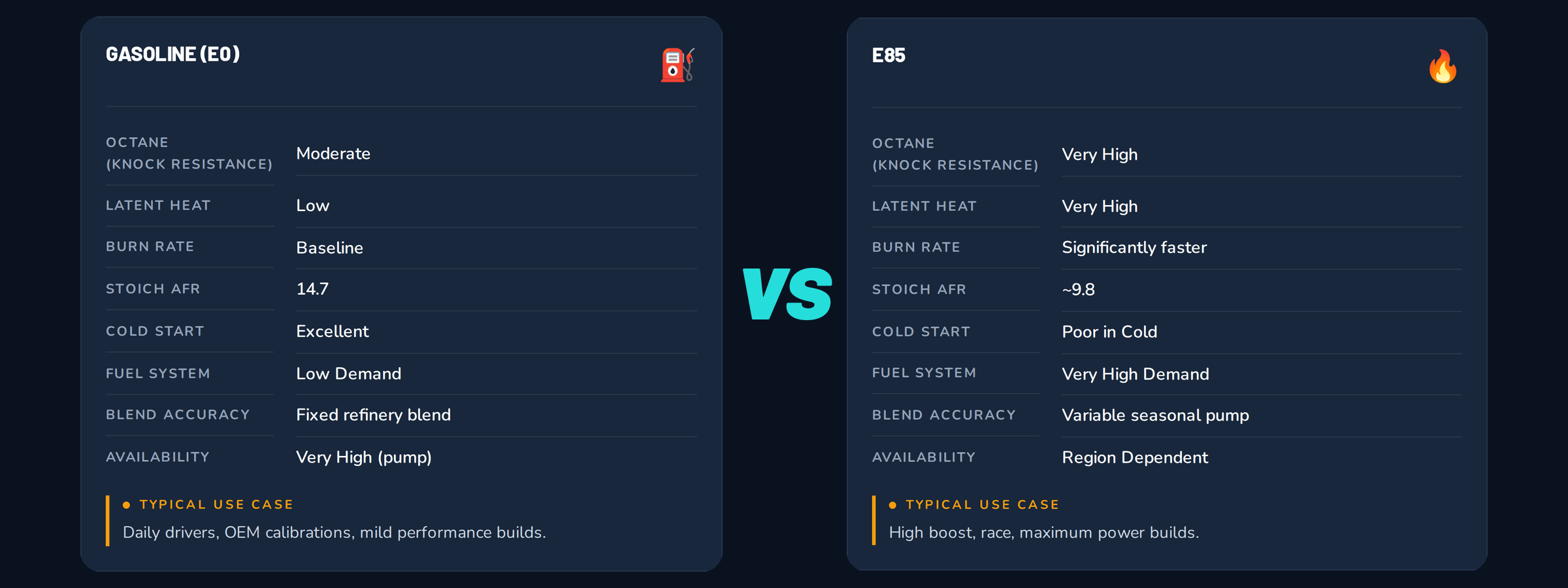
E85 is a genuinely good fuel, but where the power comes from, and where the calibration decisions come from, has nothing to do with the flex-fuel kit and everything to do with the fuel itself. Changing to ethanol blends means a handful of fuel properties change all at once, and each one drives a different decision in the calibration. Once you understand them, those decisions stop being guesswork and you just work your way through it.
In this article we're going to work through what actually changes when we move to E85. We're also going to look at why we need more fuel, why that extra fuel isn't where the power comes from, and the three properties that actually affect our power potential.
Why E85 needs more fuel
Let's start with the air, because that's what makes the power. For any given operating point, the mass of air the engine takes in is set by its mechanical design, the displacement, how well it's breathing (VE), and the air density at the time. Density itself shifts with the engine package (boost, cams, the rest of the induction system) and with atmospheric conditions (pressure, temperature, humidity), so the upper limit moves with those variables. The choice of fuel sitting in the tank doesn't set it. We'll see in a moment that a high-latent-heat fuel like E85 can cool the charge enough to nudge density upward, but that's a property of the fuel doing work on the air, not the fuel itself setting the limit.
The fuel does get a small say. On a port injected engine, we spray the fuel into the intake air stream, and that fuel takes up room that would otherwise be air. So, a fuel like E85, where we're injecting a lot more of it, displaces a little more air on the way in. Direct injection sidesteps most of that by injecting straight into the cylinder. Either way the point holds. The air available to us is largely capped by the engine, and we're not trying to change that here. What we're doing is matching the fuel to the air we've got available to us.
So, the real question is how much fuel do we need, to go with that air. Enough to use up all the oxygen that came in with it, and that's exactly what the stoichiometric ratio tells us. For gasoline it works out to 14.70 parts air to one part fuel. For E10 it's 14.10, and for E85 it's 9.81. The lower the number, the more fuel it takes to consume the same mass of oxygen.
So why is E85's ratio so much lower? Because the ethanol molecule already carries some of its own oxygen. Around 35% of ethanol's mass is oxygen, built into the molecule, so when it burns, part of the oxygen it needs to fully oxidize the fuel is already on board, and so it needs less oxygen from the air to finish the job. Less air per unit of fuel means a lower stoichiometric ratio. That's all there is to it.
Put all of this together and it starts to make more sense. The air is fixed, the ratio is lower, so we have to add more fuel to hold our target lambda. Air fuel ratio is just a ratio of masses, air over fuel, so we can rearrange it to find the fuel we need.
$$m_{fuel} = \frac{m_{air}}{\text{AFR}_{stoich}}$$
Let's look at an example with some arbitrary figures to help this stick. Take a fixed 10 kg of air in the cylinder (yes, it's a big engine!). On gasoline at 14.70, that needs about 0.68 kg of fuel to achieve stoichiometry. On E85 at 9.81, the same 10 kg of air needs about 1.02 kg. Same air, near enough 50% more fuel by mass, and about 42% more by volume once we adjust for the ethanol density difference.
Here's where a lot of people get caught out though. That oxygen in the fuel doesn't make power on its own. It's tempting to think more oxygen in means more power out, but stoichiometry has already accounted for it. The ratio balances all the oxygen against all the fuel, and our lambda target is built on that ratio. It makes no difference whether an oxygen atom came in through the intake valve or arrived locked in the fuel molecule, it's the same atom doing the same job in the same reaction. The fuel's oxygen changes how much fuel we need. It doesn't significantly change how much power we make.
The counter-argument you'll hear, especially around direct injection, is that the fuel brings extra oxygen into the cylinder, so we end up with more total oxygen, more combustion, and more power. The first part is true. On a DI engine the fuel goes in after the intake valve has closed, so the fuel-borne oxygen adds to what was breathed in, rather than displacing any of it. But the second part doesn't follow, and here's why. The engine is an air pump. What limits power is how much atmospheric air we can get through the valves on each cycle, not the total oxygen tally in the cylinder once everything's mixed together. The extra oxygen coming in with the fuel doesn't raise that intake limit. It just means the matching extra fuel needs less atmospheric air per kilogram to fully burn, which is precisely why E85's stoichiometric ratio is lower in the first place. We end up burning more fuel against the same intake air, and as we'll see in the next section, the energy released comes out almost exactly the same.
On a port injected engine the picture is even cleaner. The fuel goes into the intake stream and displaces some of the air on the way in, so the gain in fuel-borne oxygen is largely cancelled out by the loss in atmospheric oxygen. Robbing Peter and paying Paul.
E85 needs more fuel because its stoichiometric ratio is lower. The oxygen in the molecule changes how much fuel we need, not how much power we make.
More fuel doesn't mean more power
If we're injecting half as much fuel again, surely that's more energy in the cylinder and more power? It's a fair question, and the answer is no, at least not from the extra fuel itself.
Pure ethanol holds less energy per kilogram than gasoline. Its lower heating value (LHV) is around 27 MJ/kg, compared to gasoline's ~44 MJ/kg. But the figure that matters in the cylinder is the energy per kilogram of air, not per kilogram of fuel, and at stoichiometric those come out almost the same. Gasoline gives 44 divided by 14.7, which is about 3.0 MJ for every kilogram of air. Straight ethanol gives 27 divided by 9.0, also about 3.0 MJ per kilogram of air. The lower chemical energy of ethanol is offset almost exactly by the lower air requirement, so for the same air at the same lambda we release about the same energy. It's also why economy drops on E85, since we're burning more fuel by volume to release the same amount of energy.
So, if we switched an engine to E85 and changed nothing else, the same air, the same lambda, the same ignition timing, we wouldn't see free power appear. We could even go backwards, because ethanol burns faster, and leaving the timing where it was now puts peak pressure in the wrong place. We'll come back to that one shortly.
The power gains from E85 are real, but they don't come from the fuel carrying more energy. They come from three of its properties, which we can leverage the moment we switch fuel. The first is charge cooling, from ethanol's high latent heat of vaporization. The second is knock resistance, from its higher octane. The third is burn rate, because ethanol burns faster. Each one drives a different part of the calibration, so let's go through them one at a time.
Charge cooling and latent heat of vaporization (HoV)
For any fuel to burn it first has to become vapor, and turning a liquid into vapor takes heat, which it pulls from its surroundings. That's latent heat of vaporization at work, and ethanol's HoV value is far higher than gasoline's, somewhere around 840 to 920 kJ/kg against roughly 305 to 350 for gasoline. Vaporizing E85 pulls a lot more heat out of the intake charge and surrounding components as a result.
A cooler charge is a denser charge, and that helps us in two ways. A denser charge packs more air and fuel mass into the cylinder for the same displacement, which is a volumetric efficiency gain, and that's real extra power. The lower charge temperature also drops the end-gas temperature, which buys us knock margin as well before combustion even starts.
There's an important nuance here, because this part is commonly misunderstood. Most of the charge cooling we can get is already there the moment we inject the fuel, even at lambda 1. Going richer on the same fuel only adds a little more in the way of a temperature drop. On a port injected gasoline engine, moving from lambda 1 to best-power lambda (around 0.86) adds barely a degree or two of charge cooling on gasoline for a lot of extra fuel. The big levers are the fuel itself and how we inject it. Switching to a high latent heat fuel like E85 cools the charge far more than richening a gasoline tune ever could. With direct injection 70 to 80% of the theoretical maximum cooling effect is realized by lower intake charge temperatures, against around 30% for port injection. This is one of the reasons direct injection is so effective for increasing knock margin.
While we're here, one more thing to keep straight. A richer mixture drops exhaust gas temperature, but that drop is mostly from the partial burning of the extra fuel, not a one for one drop in charge temperature. Lower EGT is a genuinely useful tool for protecting valves, turbos, and cats, but don't read it as proof you've cooled the intake charge by the same amount. The two are only loosely linked.
Most of the charge cooling is there the moment we inject the fuel. Going richer adds little. The big levers are the fuel we choose and how we inject it.
Knock resistance and why the blend matters
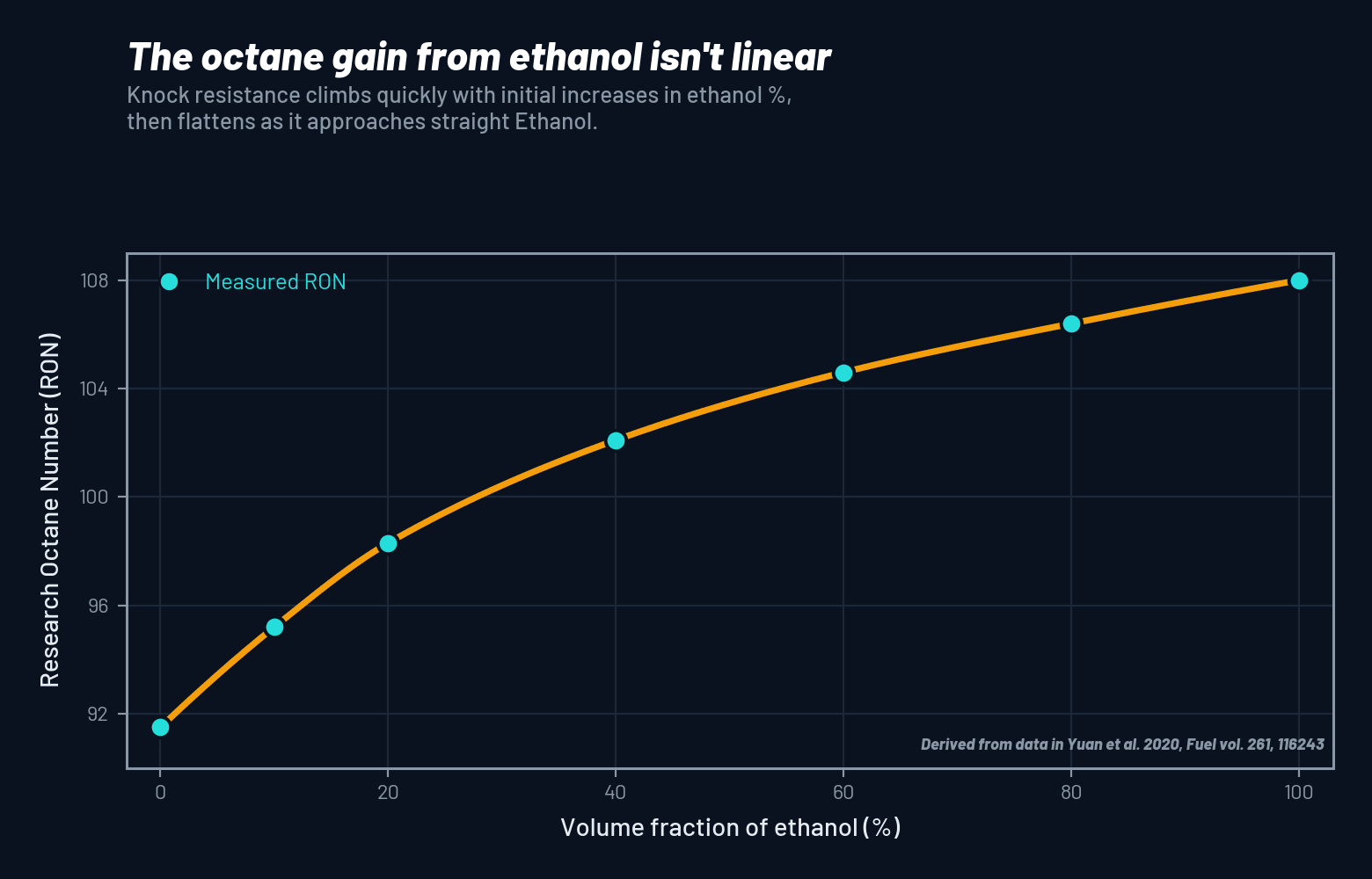
Ethanol resists knock well, which is the headline reason it's so popular on boosted and high compression engines. Neat ethanol sits around 106 to 108 RON, and pump E85 lands somewhere between about 102 RON at 50% ethanol and 106 RON at 85%.
There's a couple of things worth noting about the octane rating of ethanol blends. The first is that the octane gain from ethanol isn't linear. Blend ethanol into gasoline and knock resistance climbs quickly at first, then the curve flattens off around 40 to 50% ethanol. Past that, more ethanol does very little for octane, because we're already close to neat ethanol's ceiling.
The second is that pump E85 isn't a fixed blend. In most countries anything from about 50 to 85% ethanol can be sold as E85, and suppliers lean it towards more gasoline in winter to assist with cold starting performance. The octane, the stoichiometric ratio, and the charge cooling all shift with whatever's in the tank that week. That's why a flex fuel sensor earns its place. It lets the ECU read the actual ethanol content and adjust fueling, timing, and boost to match, so the calibration stays valid across the range rather than being right for one blend and wrong for the next.
Keep in mind that knock resistance is condition dependent as well as blend dependent. A fuel that holds up on a cool day can sit much closer to the edge after a hot soak or under sustained load, so we validate across the range of conditions the engine will actually see, not just the one it happened to be tuned in.
There's one more point that carries straight over from gasoline tuning. Octane is only worth something if we spend it. A higher knock threshold does nothing sitting there. We turn it into power by advancing timing towards MBT, the minimum advance for best torque, in regions that were previously knock limited, or by adding boost where the hardware allows. This brings us to the fuel property that catches the most people out when switching to ethanol blended fuel from a gasoline only calibration.
Burn rate and why timing moves both ways
The third property is burn rate, or how quickly the mixture is consumed once the spark fires. Ethanol's flame front travels faster than gasoline's, so once combustion starts, pressure builds more quickly and the burn finishes sooner. This is the one that catches people out, because it works directly against the assumption that more octane means more timing everywhere.
To see why, remember what we're aiming for with ignition timing. We want peak cylinder pressure to land in the same window, around 14 to 18 degrees after top dead center, regardless of fuel, because that's where it has the best leverage on the crank and we can extract the most work from the in-cylinder pressure. Combustion takes time, so we fire the spark early enough for peak pressure to arrive in that window. That's MBT. Change how fast the fuel burns and we change how much lead time we need to get there.
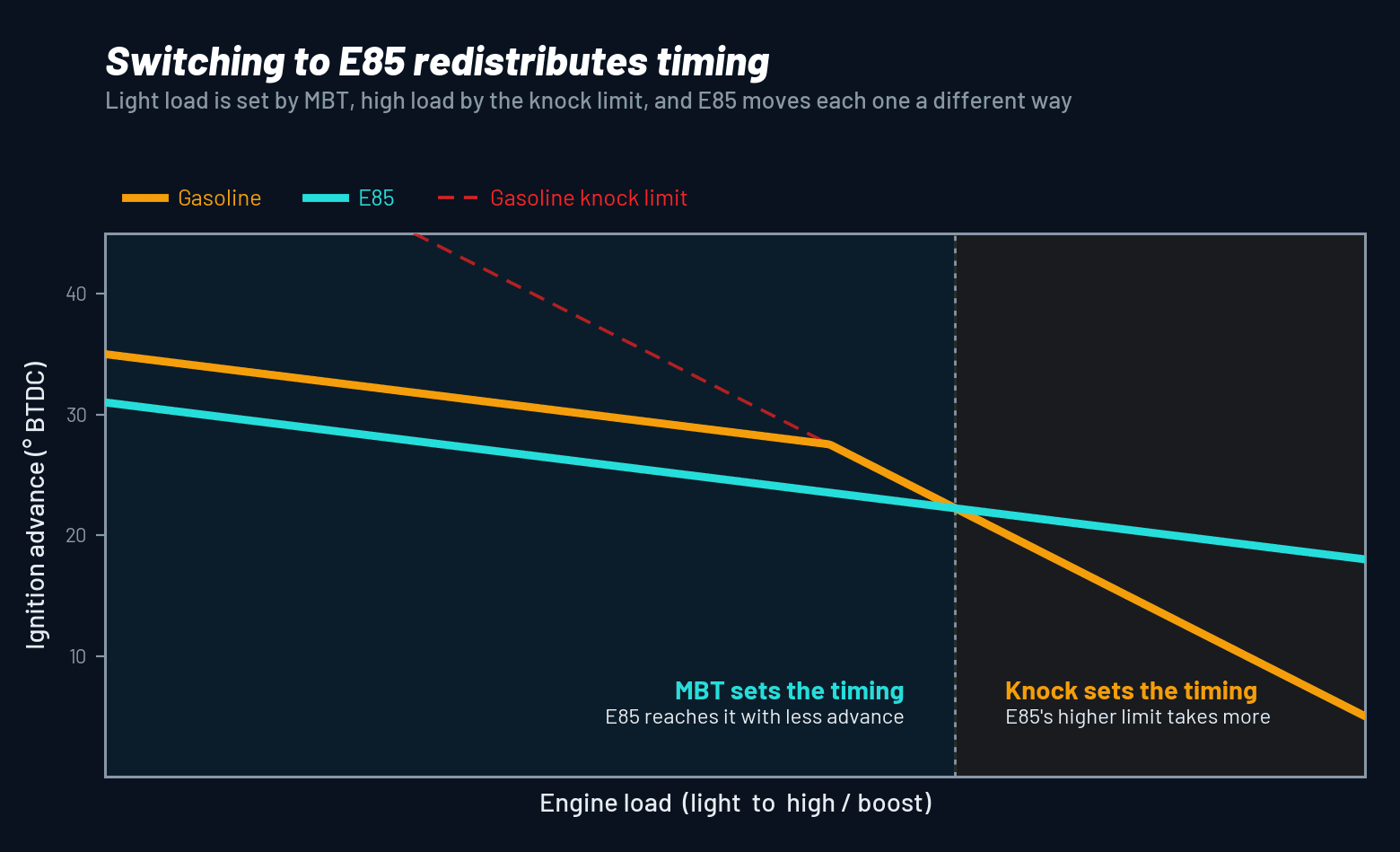
Now split the map into two regions. In the areas that were already at MBT on gasoline, usually light to moderate load where knock wasn't the limit, the phasing was already optimal. Switch to ethanol and the faster burn brings peak pressure earlier if we leave the timing alone. To put peak pressure back where it belongs, we need to reduce timing. We run less advance even though the fuel has more octane, simply because it now reaches MBT with less lead time.
In the areas that were knock limited on gasoline, usually high load and boost, we often can't reach MBT on gasoline because knock stopped us first. Ethanol's higher knock threshold lets us advance further towards MBT, or add boost, before knock may or may not become our limiting factor again. We gain some advance from the fuel change already, but owing to the increase in octane rating we can continue advancing timing towards MBT until it's either reached, or a new Knock Limited Spark Advance (KLSA) value is reached on the new fuel.
So, converting a gasoline tune to E85 is a redistribution of timing, not a uniform increase. Some cells want less, some want more, and which way a cell goes depends on whether it was knock limited on gasoline, not just based on the octane number difference. In practice that means we don't drop a single global offset across the whole timing map and call it done. We re-optimize it, pulling advance out of the cells that were already at MBT and adding advance into the cells where the knock limit has moved.
The faster burn helps in one more way. A quick burn releases its heat over a shorter window and loses less of it to the cylinder walls along the way, so more of that energy ends up as pressure we can actually use. That's a small but real contribution to power in its own right, on top of the timing we free up in the knock limited zones. Just keep the mechanical side in view. If ethanol lets the engine run closer to MBT at high load, cylinder pressure and torque go up, and that load lands on the pistons, rods, head gasket, bearings etc. More timing and more power always has to be checked against what the hardware can take.
Switching to E85 redistributes timing, it doesn't add it everywhere. Zones already at MBT often want less, zones that were knock limited can take more.
Cold starts and what the fuel system has to deliver
Those property changes come with some practical consequences, and they're the price of entry for everything above.
The first is cold starting. Ethanol has a much lower vapor pressure than gasoline, and that high latent heat of vaporization property now works against us. When the engine's cold the fuel struggles to vaporize, and combustion needs vapor, not liquid. On a true E85 blend you'll see the first signs of hard starting around 10°C (50°F), and it gets genuinely difficult down near 5°C (41°F), even with a lot of fuel going in, because so much of it stays liquid. Cranking and post-start enrichment of 100 to 200% over gasoline is normal, and it's why suppliers mix more gasoline into their winter blends, often down to 50 to 70% ethanol. This ensures there are enough light, easily vaporized components to get the engine starting. Running ethanol properly means a flex fuel sensor and a deliberate cold-start strategy, not just larger injectors.
The second consequence takes us back to where we started. Around 50% more fuel by mass, every cycle, means the injectors, the pump, and the lines all have to move more fuel. As ethanol content climbs, injector duty cycle rises, the pump has to flow more, the regulator has to keep up, and every wetted component has to be alcohol compatible. Moving to a high ethanol blend usually means bigger injectors, a bigger pump, and the right materials throughout. The Injector Sizing Calculator will show you how the fuel change affects the size you need.
Step back and there's a clean pattern in all of this. Ethanol moves the limiting factor. On gasoline at high load, the thing stopping us is usually knock. On E85, knock margin opens up and the limit moves to the hardware, to fuel system capacity, and mechanical strength. That's why choosing a fuel is a decision about the whole build, not just the tune, and it's exactly what the Fuel Selection Matrix is built for. It lays out the properties and trade-offs of each fuel, side by side, so you can choose deliberately rather than defaulting to one fuel only to find its hidden limits later.
Ethanol moves the limiting factor from combustion stability to hardware capability.
Key points
- The air an engine takes in is capped by its mechanical design, so we match fuel to that air. Because E85's stoichiometric ratio is lower, about 9.81 against 14.70 for gasoline, it takes roughly 50% more fuel by mass to use up the same oxygen.
- The oxygen carried in the ethanol molecule is why that ratio is lower, but it doesn't make power on its own. Stoichiometry already counts it, and our lambda target is built on the ratio.
- More fuel isn't more energy. The energy released per unit of air at a given lambda is about the same as gasoline, so the extra fuel holds lambda rather than adding power.
- E85's power comes from three properties that change with the fuel. Charge cooling from its high latent heat of vaporization (a denser charge and more knock margin), higher knock resistance (room to advance or add boost where we were knock limited), and a faster burn rate.
- Because ethanol burns faster, switching to it redistributes ignition timing rather than adding it everywhere. Zones already at MBT often want less advance, while zones that were knock limited can take more.
- Pump E85 varies from about 50 to 85% ethanol, so octane, stoichiometric ratio, and charge cooling all move with the blend. A flex fuel sensor keeps the calibration valid across that range.
- The cost of entry is cold-start enrichment, more fuel system capacity, and alcohol-compatible hardware. Ethanol moves the limiting factor from combustion stability to hardware capability.
Related Resources
The stoichiometry, charge cooling, knock resistance, and burn rate fuel properties, are covered in depth in Stage 3, Fuel and Combustion, which sits inside both the Calibration Competence and EFI Master Programs. If you want to know which program is best suited to your goals, do the free assessment and it'll point you in the right direction.
Find Your ProgramGet notified of new articles
One article per week on EFI fundamentals, calibration principles, and diagnostic thinking. No spam.
You're subscribed. We'll let you know when new articles are published.