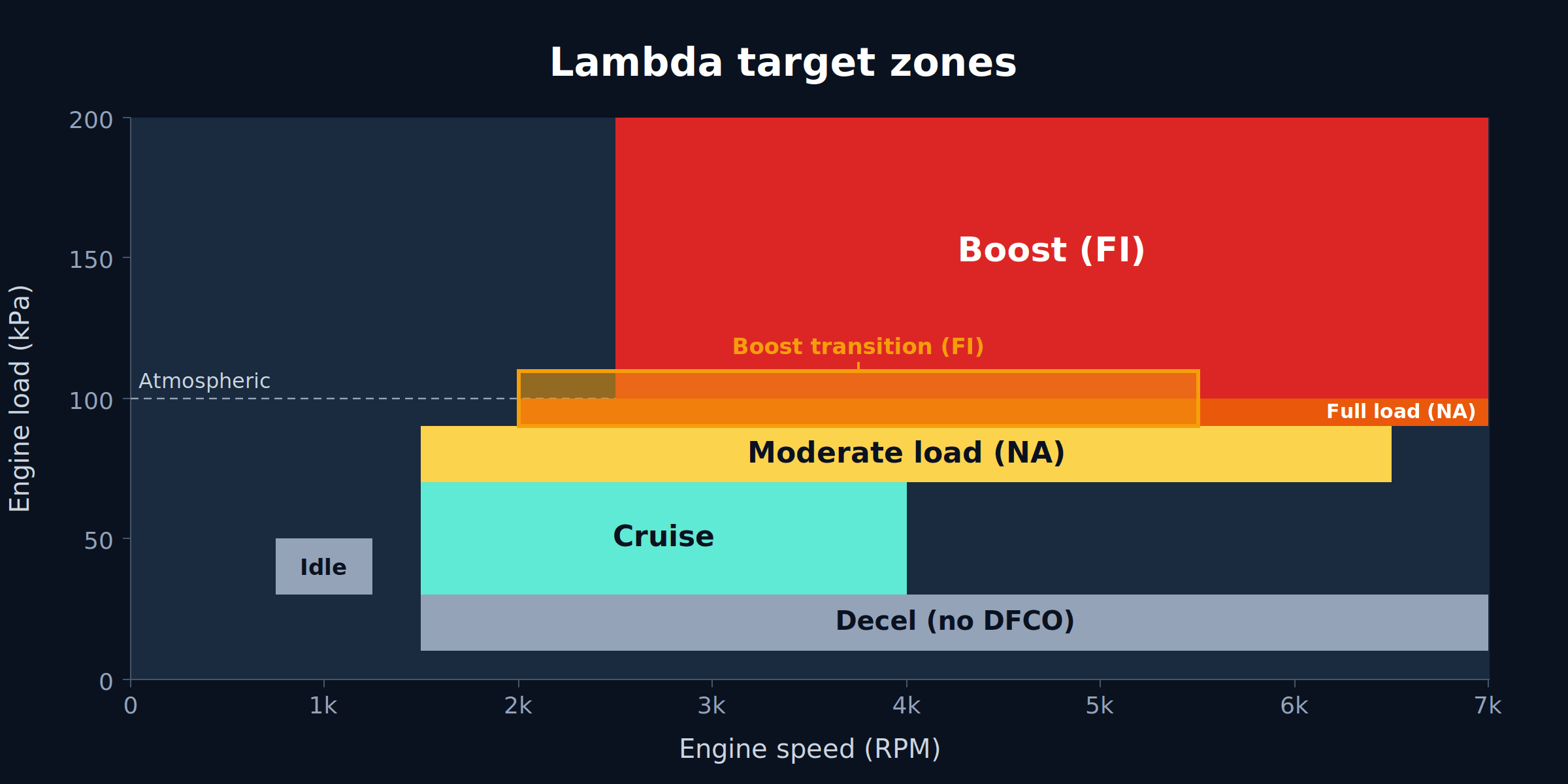
In other words, the lambda targets move because what you're asking the engine to do changes. At idle you need combustion to be stable. At cruise you want fuel economy. At high load you want power, and on a forced induction engine you also want enough fuel to keep the engine out of trouble. Different objectives, different targets.
Plenty of lambda target advice circulates as numbers in a table. Here's how to work through lambda target selection, zone by zone, so when you sit down with an unfamiliar engine, you have a sensible starting point and a clear idea of what each value will do for the engine.
What goes in the target table and why it varies
A lambda target table is simply how rich or lean you want the mixture to be in every cell of the operating map. Each cell effectively documents a decision you've made about what you're asking the engine to do at that point.
At any given operating point, we have several objectives we can choose from. Combustion stability, fuel economy, emissions output, power, and component protection. Each objective wants a different target. Which one wins out depends on where you are on the map and how the engine is being used. No single lambda value satisfies all of them, and the operating point determines which objective becomes the primary driver behind our decisions.
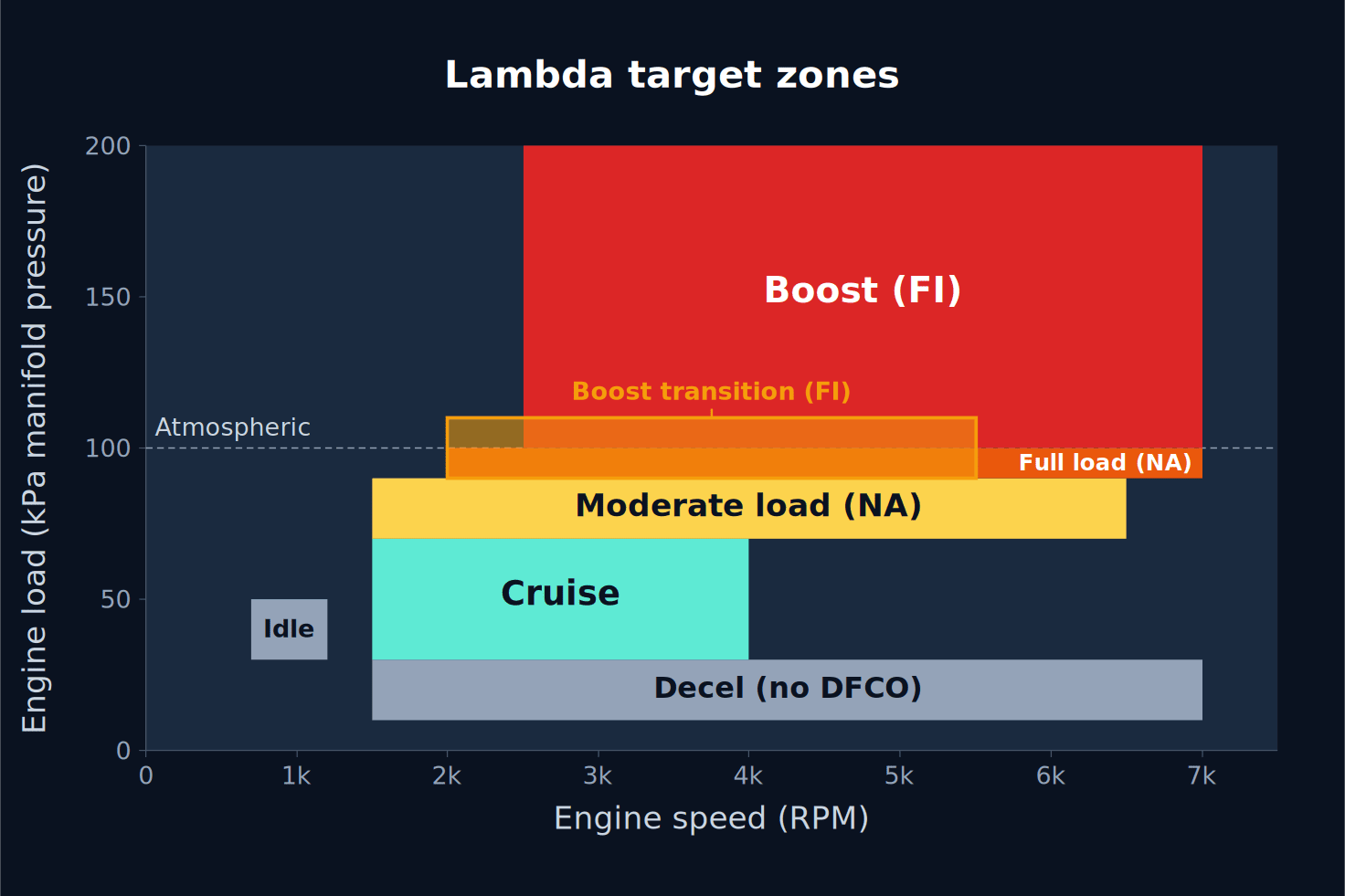
Generally, the entire operating range of an engine is divided up into areas or 'zones' that will then be assigned a primary objective. These zones are idle, cruise, moderate load, full load (Naturally Aspirated), boost transition, boost, and decel, and the lambda target for each zone is the one that supports that zone's objective the best. In the rest of this article we'll go through each of these zones, how we can establish some solid starting lambda targets, and some pointers for when things might deviate from the norm.
Idle
At idle, the engine is running at low cylinder pressure with a small throttle opening, slow combustion, and minimal load. The primary objective in this zone is combustion stability. The flame kernel at the spark plug needs good mixture quality to develop into a clean burn, cycle after cycle. If the mixture is too lean, cycle-to-cycle variation grows, idle quality deteriorates, and at the limit, you start getting partial misfires. Too rich, and you'll eventually foul your spark plugs which also leads to unstable combustion and a rough idle.
Lambda 1.0, or stoichiometric, is the starting point at idle on most engines. Stoichiometric is the ratio at which the air and fuel in the cylinder match the proportions needed to theoretically consume all the available oxygen during combustion. Two reasons it works for idle. First, a stoichiometric mixture provides the combustion stability that a low-pressure operating point needs. Second, if the engine has a catalytic converter, three-way catalysts only operate effectively in a narrow window around lambda 1.0. Rich or lean of that window and conversion efficiency drops sharply, which matters for emissions compliance and for how long the converter lasts.
On engines with large camshaft profiles and high valve overlap, idle vacuum is usually low and combustion behaviour is harder to predict. In these cases, you'll often want to run a slight enrichment to around 0.90-0.98 lambda for stability. The starting point is still 1.0. The cam profile, and the idle quality once the engine is running, will tell you whether to move off lambda 1.0 and by how much.
Blindly targeting a number isn't the name of the game. If the engine needs more or less fuel to run smoothly, then give it what it wants.
Power isn't the objective at idle, and economy isn't either given that idle fuel flow is small in absolute terms, regardless of the target. Idle is about consistency without under or over fuelling.
Cruise and light load
At cruise and light load, the engine is doing a small amount of work at part throttle. Vehicle speed is fairly steady, and on a street car this is where the engine spends most of its operating life. Fuel economy has the most practical impact here, so it becomes the primary objective.
Best economy on gasoline or ethanol-blended fuel isn't lambda 1.0. It's slightly lean of stoichiometric, in the range of 1.03 to 1.05 lambda, depending on engine design. The engine is consuming less fuel per cycle than at stoich, and the load is modest enough that it can still produce the torque needed to maintain road speed.
Where things become less intuitive is what happens when we continue to lean the mixture out to chase further economy gains. Run leaner than around 1.08 to 1.10 lambda and combustion slows down, torque per cycle drops, and to maintain the same vehicle speed the throttle needs to be opened further. A wider throttle opening draws more air through the engine, which means the ECU adds more fuel even with the leaner target, because the absolute air mass flow has gone up. The economy benefit drops to zero and the leaner we go the worse our economy will get until the engine no longer has enough fuel to reliably run. The practical optimum on most engines is 1.03 to 1.05 lambda, not the leanest the engine will tolerate.
Best economy isn't the leanest mixture the engine will tolerate. Past 1.08 to 1.10 lambda the throttle opens further to hold speed, and the extra airflow demands more fuel which is used less efficiently.
Lean mixtures also burn slower than stoichiometric ones, which affects how much ignition advance the engine wants. The connection between combustion speed and MBT timing is covered in the ignition timing and MBT article, but it's common to advance timing when running lean mixtures for fuel economy.
If the vehicle has a catalytic converter and needs to stay emissions compliant, the cruise picture changes. Three-way catalysts need lambda 1.0 to do their job, so cruise targets get held at stoich and the economy benefit of lean burn is given up. That's just the trade-off between fuel economy and emissions at play. On a street car running a catalytic converter, lambda 1.0 at cruise is going to be the right call.
Moderate load
Once the throttle opens further and load increases, the picture changes. Manifold pressure is increasing, cylinder pressure is climbing, and the engine is doing more work than it was at cruise. The lean economy target that worked at part throttle no longer makes sense here.
On a naturally aspirated engine, moderate load is still below atmospheric pressure, and the lambda target moves rich of stoichiometric to somewhere between 0.92 and 0.96. There are two reasons. First, the economy gains from running lean shrink as the engine does more work. Whatever percentage of fuel you were saving compared to a stoichiometric target stops mattering when the engine is consuming several times as much fuel per cycle as it was at cruise. Second, knock margin starts to tighten. Cylinder pressure and end-gas temperature both rise with load, which moves the engine closer to the threshold where knock can occur and we start to add a little enrichment to compensate for this and keep our combustion events stable and predictable.
The variables that influence the knock threshold (ignition timing, boost, intake air temperature, coolant temperature, fuel octane, AFR, and engine speed all acting together) are covered in the knock threshold variables article, so take a look to understand these in more detail.
Cruise economy is no longer the priority, but full-load enrichment isn't justified yet either. The job here is to keep combustion stable, keep knock margin healthy, and prepare the engine for the heavier work coming at higher throttle percentages and loads.
Full load (NA)
At full throttle on a naturally aspirated engine, the engine is being asked to produce its maximum output. The primary objective shifts to power production and keeping the engine safe at the same time. Lambda targets move firmly rich of stoichiometric in this zone.
On naturally aspirated engines, you'll typically start around 0.88 to 0.90 lambda at full load, with final values expected in the 0.86-0.92 range.
Three things happen as the mixture goes rich of stoichiometric, and this is applicable to Boost zones as well.
The first is oxygen dissociation. At the high temperatures and pressures inside the cylinder during combustion, some of the CO2 and H2O molecules that have already formed break apart again, releasing oxygen atoms that react with the surrounding burned gases. The additional heat released by these reactions expands the cylinder gases and raises peak pressure. The model is simplified, but the effect is real and adds to the work done on the piston.
The second is combustion speed. A rich mixture, up to a point, combusts faster than stoichiometric. With ignition timing optimised, both a fast burn and a slower burn put peak cylinder pressure at the same place after TDC, but the faster burn gets there with less ignition advance, which means less of the pressure rise happens before TDC where it works against the piston. The result is more useful work on the crankshaft from the same air mass. There's also a knock margin benefit, because a faster burn gives the end-gas less time to autoignite before the flame front reaches it.
The third is charge cooling. As the fuel evaporates from liquid into vapour, it absorbs heat from the surrounding air through latent heat of vaporisation. A richer mixture means more fuel evaporating, which means more cooling. A cooler intake charge is also a denser intake charge, and a denser intake charge can carry more oxygen. There's also a knock margin benefit, because cooler end-gas takes longer to reach autoignition.
The magnitude of the charge cooling effect on gasoline is often overstated. From lambda 1.0 to lambda 0.85 on straight gasoline, the maximum theoretical change in intake charge temperature is roughly 3°C. With port injection, you're getting about a third of that in practice, because most of the fuel evaporation happens off the intake port and manifold surfaces rather than from heat in the air itself. Direct injection captures more of the effect, at around 70 to 80%. Fuels with much higher heat of vaporisation, such as E85 and methanol, deliver a significantly larger cooling effect because each kilogram of fuel absorbs more heat as it evaporates.
There's a limit to how rich you should go. Past around 0.80 to 0.85 lambda on most gasoline or ethanol blended fuels, the additional fuel has long run out of oxygen to react with. The mixture starts forming localised rich and lean pockets, which slows flame propagation, and affects combustion stability. Well past best-power lambda, the engine drops into rich misfire which opens up a whole other set of problems and potential engine damage. Practical issues appear before that point though. Bore wash from excess fuel strips oil off the cylinder walls, while direct-injected engines become more susceptible to Low Speed Pre-Ignition (LSPI) at very rich mixtures when combined with high cylinder pressures. Fuel system demands also rise sharply at excessively rich mixtures for diminishing returns in power. More is not better, and there are far more effective ways to cool your intake charge than to dump an unnecessary amount of fuel through the engine.
On a catalyst-equipped vehicle, sustained operation below 0.80 lambda will accelerate catalyst wear. High exhaust temperatures and the rich mixture both work against the catalyst, so on a street car with emissions equipment, you need to consider this when choosing your targets.
The starting targets above are exactly that. Starting targets. Every engine will respond a little differently based on combustion chamber design, compression ratio, fuel quality, charge temperatures, and the specific knock behaviour of the platform. Dyno testing with knock monitoring active is what ultimately tells us where the engine is happiest and what the targets need to be.
Boost transition
On a turbocharged or supercharged engine, the zone between cruise and full boost has its own target requirements. As manifold pressure climbs from vacuum through atmospheric pressure and into positive boost, lambda typically decreases from around 0.92 down toward 0.87 as load builds. The exact targets depend on the engine, fuel, compression ratio, and how aggressively boost comes on, as well as what your final Wide Open Throttle (WOT) lambda targets are. You're looking for a smooth blend in this zone between cruise and WOT and this will guide your targets in this transition zone.
The aim is to start enrichment before we need it. By the time positive manifold pressure arrives, we want enough fuel in the mixture to support the charge cooling and knock margin we'll need at full boost. Starting enrichment too late risks a knock event during the boost ramp. Starting too early just wastes fuel. So, it's about finding the right balance.
Boost (Forced Induction)
On forced induction, you'll start richer, often 0.83 to 0.85 at high boost, and a touch lower in some cases depending on the application. These are starting points, not finished targets.
Forced induction engines need richer targets than naturally aspirated engines for two main reasons. First, the intake charge baseline is already elevated. Boost raises the starting pressure and temperature of the air entering the cylinder, even with intercooling, which means the end-gas during combustion is starting closer to the autoignition threshold. Additional fuel for charge cooling and end-gas stabilisation helps push that threshold back. Second, additional fuel reduces exhaust gas temperatures and helps protect the exhaust valves and downstream components from thermal damage.
This zone is no different to the Full Load (NA) zone in that there is a limit to how rich you should go. LSPI is especially problematic on direct-injected small-displacement turbocharged engines, where very rich mixtures at high cylinder pressures can trigger an LSPI event. The usual constraints around bore wash, combustion stability, and fuel system sizing are all present in this zone as well. Excessive fuel mixtures aren't the right tool for controlling temperatures. Make sure you have cool air from outside the engine bay and your intercooler (where fitted) is efficiently rejecting the heat from compression.
Starting targets are not the finished targets. Every engine responds differently, and testing, with knock monitoring active, is what tells us where the engine is happiest and what the targets need to be.
Decel
On a vehicle running DFCO (deceleration fuel cut off), there's nothing to target here. Fuel is cut entirely while the throttle is closed and the engine is overrunning, so the cells in this part of the map are inactive. The decel target only matters on calibrations where DFCO isn't employed.
In those cases, decel typically targets somewhere between 0.90 and 1.0 lambda. Closer to stoichiometric for normal street operation, where the priority is a smooth catch back into cruise and idle. Closer to 0.90 for race applications where the additional fuel through the cylinder during decel provides cooling, which is more pronounced on ethanol blends. Either way, the target should blend with the cruise and idle zones to avoid surprises under transient conditions.
Key points
- Lambda targets vary across the operating map because each zone has a different primary objective. Combustion stability at idle, fuel economy at cruise, transitional management at moderate load, progressive enrichment through boost transition, power and component protection at full load and under boost, and a smooth catch back to idle on decel
- Idle starts at lambda 1.0 for combustion stability and catalyst operation, with slight enrichment to 0.90-0.98 on engines with large cam profiles
- Best cruise economy on gasoline is at 1.03-1.05 lambda, not the leanest the engine will tolerate. Past 1.08-1.10, the throttle opens further to maintain speed and the extra airflow defeats the leaner target
- Catalyst-equipped vehicles target lambda 1.0 at cruise to keep the catalyst working, trading away the lean economy benefit
- Moderate load on a naturally aspirated engine moves the target toward 0.92-0.96 as cylinder pressure climbs, knock margin tightens, and the economy gains shrink
- Boost transition on forced induction engines ramps lambda from around 0.92 down toward 0.87 as load builds, getting enrichment in place before full boost arrives
- Full load on naturally aspirated engines runs between 0.86-0.92 lambda. Forced induction runs richer, typically 0.78-0.85 at high boost, for charge cooling, knock margin, and exhaust temperature management
- Past about 0.80 lambda the additional fuel finds no oxygen, combustion stability degrades, and bore wash, LSPI, and catalyst damage become real constraints
- Decel only needs a target where DFCO isn't employed. 0.90 to 1.0 lambda covers it, leaning toward stoich for street and toward 0.90 for race cooling, blending with the cruise and idle zones
- Starting targets are not finished targets. Validation on the dyno with knock monitoring is what determines the actual values for a specific engine
- Always test and validate and give the engine what it wants
Related Resources
That's the approach. The Lambda Selection Matrix was designed to capture this in a tool that you can use to work through the lambda targets on any engine without starting over every time. It's in Stage 3 on the Roadmap and is included in the Calibration Competence and EFI Master Programs. Take the free assessment and see which program best suits your own goals.
Find Your ProgramGet notified of new articles
One article per week on EFI fundamentals, calibration principles, and diagnostic thinking. No spam.
You're subscribed. We'll let you know when new articles are published.