The typical injector sizing formula is everywhere and drives 99% of online calculators. The difference between a number you can trust and a "hope and see" is knowing what each term stands for, which term is purely a guess, and how safety margin is or isn't built into the various calculators available.
The formula, and the one term that does the damage
Injectors are typically rated in lb/hr or cc/min, and the classic formula looks like this.
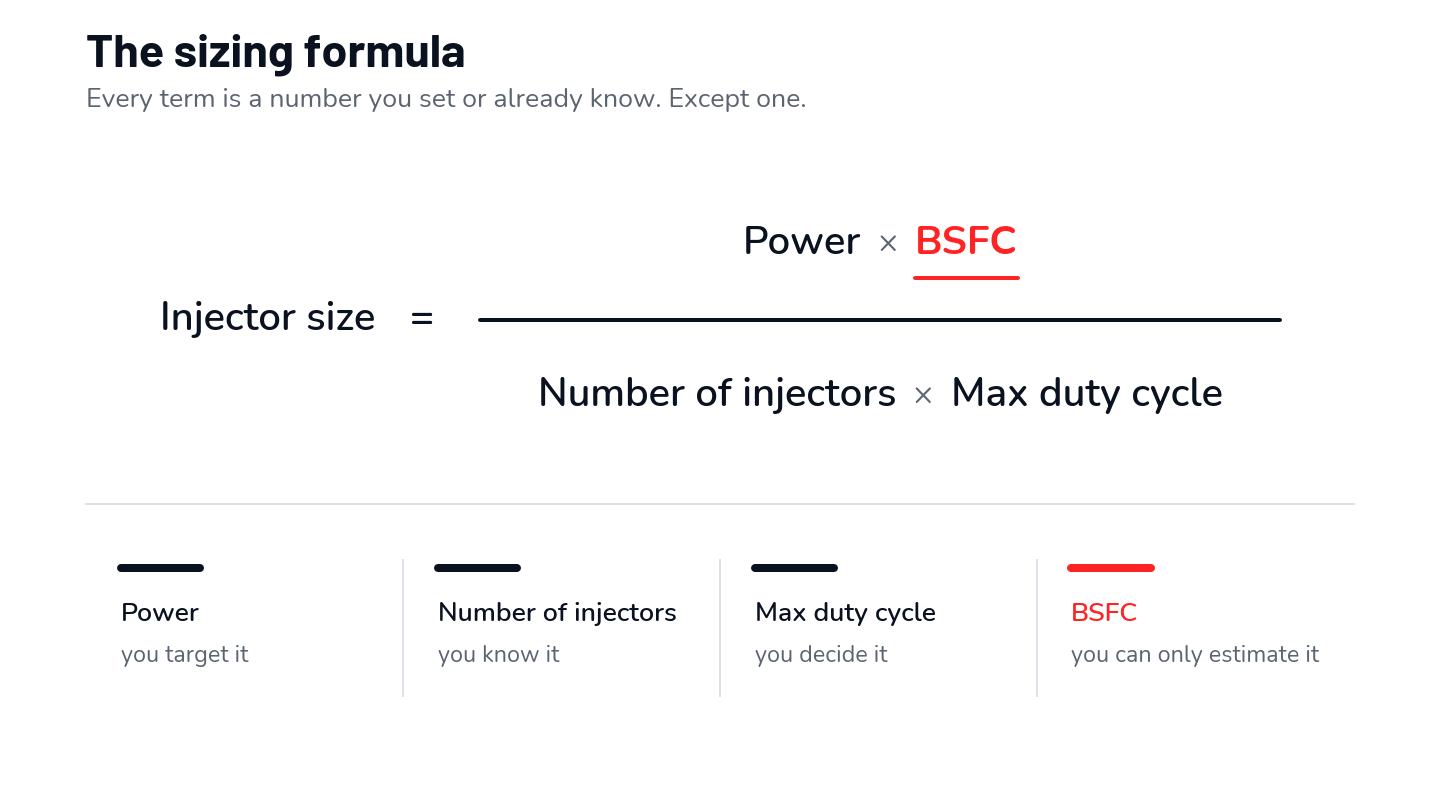
This gives injector size in lb/hr, which you can convert to cc/min using the fuel's density or by multiplying the lb/hr by 10.5 (rough rule of thumb) if you're on straight gasoline.
Underneath the formula, it is just a mass balance. The engine pulls in a certain mass of air each cycle, the fuel has to match it relative to the calibrated Air Fuel Ratio (or Lambda), and the injectors have to deliver that fuel in the time it takes to complete an engine cycle. Power stands in for airflow. Max duty cycle is how much of the available time in the engine cycle we choose to allocate for getting the fuel into the cylinder, and the total fuel delivery requirement is split across the number of injectors available.
Notice that almost every term is something you either know or decide. You pick a power target. You know how many injectors you've got. You set the maximum duty cycle you're happy with. Then there's BSFC, which is the odd one out, because it's the only term in the formula nobody can actually look up for their specific engine.
Nobody knows what BSFC to use
Brake specific fuel consumption is the mass of fuel an engine burns per unit of power per hour, in lb/hp·hr or g/kWh. The lower the number the more efficient the engine is at making power from a given mass of fuel. That part's simple enough.
Where we run into trouble is what BSFC bundles together into that final number. BSFC rolls up the engine's efficiency, your AFR target, and the fuel's energy content, into a single number, and that number isn't printed on any spec sheet for your particular combination. So, people grab a value off a chart or a forum somewhere and hope for the best. The usual ranges tell the story. Naturally aspirated gasoline runs about 0.40-0.55, turbo gasoline about 0.55-0.75, and E85 on boost about 0.75-0.85. Those are pretty broad ranges, and where you land inside them depends on how rich you're targeting and how hard you're leaning on the engine in terms of ignition timing. Pick the wrong end of the range and you're stuck with it right through the calibration process.
What pushes BSFC up isn't arbitrary, it's a handful of physical effects you'll probably be familiar with. Under boost you target a richer mixture to keep combustion stable and charge temperatures down, so you're deliberately burning more fuel than stoichiometric. E85 stacks another effect on top. Since it carries less energy by mass than gasoline, you simply need more of it to produce the same power.
BSFC is the only term in the formula that isn't a spec or a decision. It's a guess, and it's the guess the whole result rides on.
How to size injectors without guessing BSFC
This is where the empirical method in the Injector Sizing Calculator comes in. Instead of asking you for BSFC, it works from a fuel flow figure you can actually reason through. A gasoline engine making 1000 hp at lambda 0.85 needs roughly 6 litres per minute of fuel. From there it scales by the things you know about (fuel type, stoichiometric ratio, your chosen lambda target, engine type, and fuel pressure).
The method isn't skipping BSFC, it's choosing a sensible one for you. Six litres a minute on gasoline works out to about 0.59 lb/hp·hr, a reasonable number for a gasoline engine, so the calculator has effectively made the BSFC call for you. The difference is it makes the choice you can't confidently make yourself, then scales it for your fuel type and target lambda, rather than leaving you to dig a value out of a table, or guess.
It's also deliberately conservative. The E85 scaling, for example, doesn't take credit for the thermal efficiency you usually gain on ethanol from the extra timing and charge cooling, which leaves roughly 10-12% in hand. The assumptions are all spelled out under the calculator's notes, and they're worth reading before you trust any sizing number, regardless of who produced it. If we understand the 'why', we can reason from there and work out the 'what'.
Duty cycle is a time budget, and 80% is a legacy number
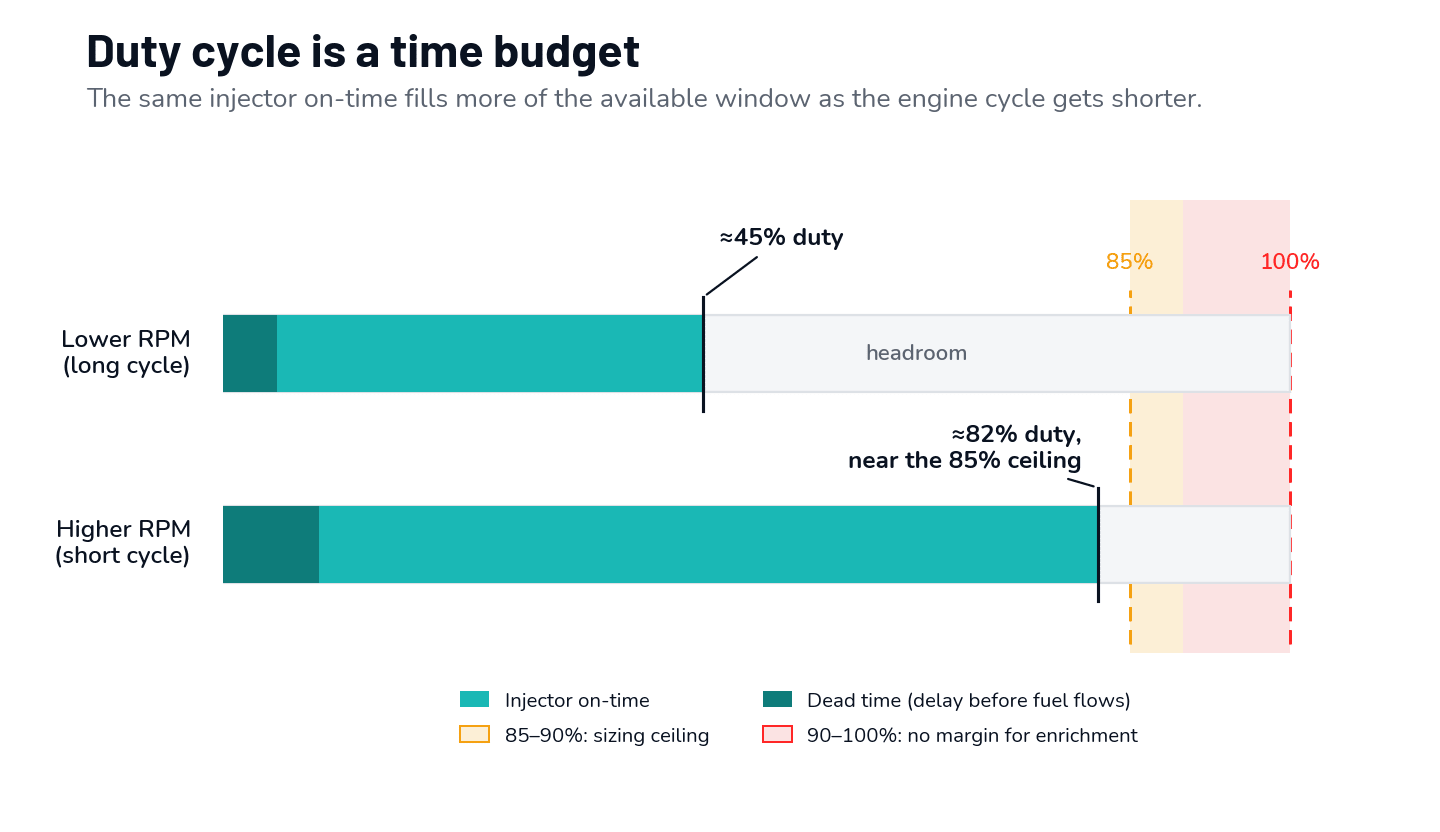
Duty cycle is simply the ratio, expressed as a percentage, of the total injector on time (in milliseconds) vs the engine cycle time (in milliseconds). Because duty cycle is relative to Engine cycle time, the same injector on-time can produce different duty cycles, depending on where in the RPM range the engine is operating.
$$ \text{Duty cycle (\%)} = \frac{\text{Injector on-time (ms)}}{\text{Engine cycle time (ms)}} \times 100 $$
It's an easy one to mix up, so it's worth being clear on what it is not. Duty cycle isn't flow, and it isn't pulse width. Flow is mass or volume per unit time. Pulse width is the time the injector is commanded to be open by the ECU, in milliseconds. The way the ECU arrives at that pulse width is via the fuel equation. At 100% duty cycle the injector never closes, which is also why moving to a larger injector helps. A bigger injector delivers the same mass of fuel in less time, so its on-time relative to the available cycle time drops, lowering the duty cycle at that operating point.
You'll see 80% quoted as the safe ceiling almost everywhere for injector duty cycle. That number has been around for decades. It comes from an era when injectors weren't consistently characterized and ECUs didn't have good dead time, low pulse width, or flow data to work with, so you stayed well clear of the top end because you couldn't fully trust what the injector was doing up there. The buffer was insurance against unpredictable behaviour at a point where you least want unpredictability.
A properly characterized modern injector on a competent ECU removes most of that uncertainty, so 85-90% is a safe continuous maximum under normal conditions. Pair it with a conservative flow estimate like the one above and your real in-service duty cycle sits below the number you sized to. What the remaining headroom buys you is important though, so let's look at that in a little more detail.
Injector dead time, the delay between the ECU energising the injector and it actually starting to deliver fuel, eats part of every pulse, and transient enrichment and fuel compensations also need to be accounted for. Other operating conditions also work against you. Hot fuel loses density so you deliver less mass per pulse, low voltage stretches the injector's required opening time, and fuel pressure can decrease under sustained demand. All of these scenarios will require the injector on time to extend, and this is exactly what the duty cycle headroom is there for. Reasonable maximum duty cycle numbers for injector sizing would be nearer to 85% on a return system that tends to heat soak the fuel, or for older, less characterized injectors. Use 90% when the estimate is padded and the rest of the fuel system is solid.
100% duty cycle doesn't mean maximum power. It means you've run out of time to add fuel, including the fuel that enrichment, compensation, and changing conditions still might require.
Rated flow is a single pressure snapshot
Everything so far assumes the injector actually delivers its rated flow. That rated number comes with a condition that's easy to overlook, because it's only true at one specific pressure.
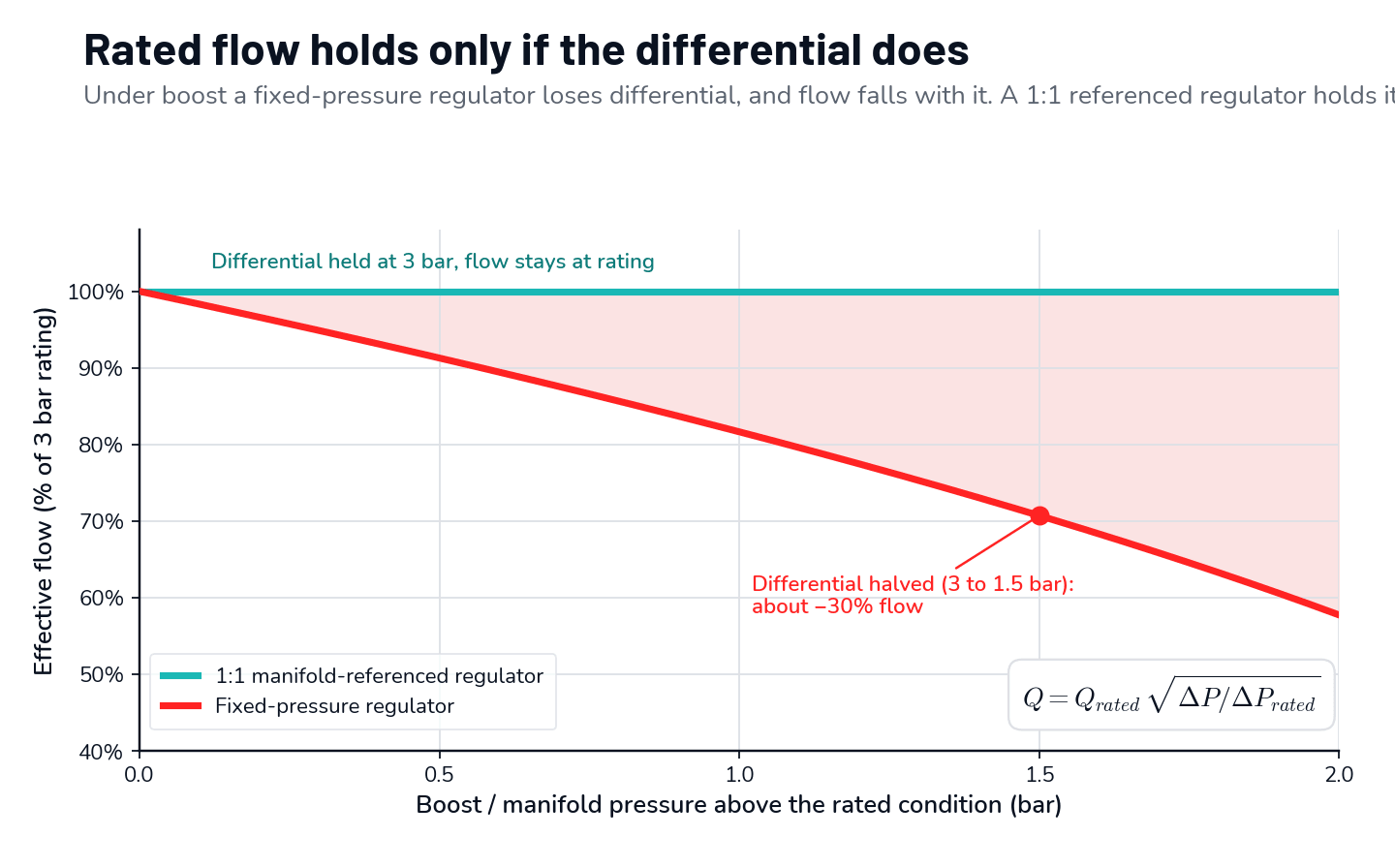
A port injector's rated flow is quoted at one reference differential pressure, which is usually 3 bar (43.5 psi). Flow, in general, can only come from a difference in pressure between two points, so it is always the differential pressure between the fuel rail side of the injector and the manifold that will determine the actual flow rate of the injector. The injector responds to the difference between rail pressure and manifold pressure, not just rail pressure on its own. Bring a turbo into it and manifold pressure climbs under boost. If the regulator holds rail pressure at a fixed value, the differential falls and effective flow falls with it, right when the engine wants more fuel. Flow scales with the square root of the pressure ratio, so the change isn't linear. Double the pressure and you pick up around 40% additional flow. Halve your pressure, and you lose around 30% of your flow. This is the square root effect.
That's why a manifold-pressure-referenced fuel pressure regulator, that scales at a ratio of 1:1, matters in a boosted setup. It holds the differential constant, so the injector flows its rated value across the whole boost range, regardless of manifold pressure. The Fuel Pressure vs Flow Calculator lets you see how flow shifts as the differential pressure changes. The sizing calculator handles this for you too, scaling the required injector flow rate back to the standard 3 bar rating, so you can compare directly against manufacturer specs. You can optionally enter an alternative pressure to see how this affects the required injector size, scaled to 3 bar as well so you're always able to shop for the correct sized injectors.
Just remember, rated flow is one number at one pressure. Change the pressure across the injector and you change the flow, whether you meant to or not.
Where it still goes wrong
A good injector sizing method removes the BSFC guess and the pressure trap, but two things can still trip you up. The first is the power figure you put in. Don't put in 1000hp if your engine is designed and built to run 400. By the time you actually have an engine that can run 1000hp, all of your requirements will be different, and you may have staged injection which changes the injector sizing maths via the Number of injectors parameter in the equation. Chances are you'd also be running a different fuel, and likely different lambda targets. The second is assuming the rest of the fuel system can keep up. An injector can only flow its rated number if the pump and regulator hold pressure under sustained demand. Even if you have a sensible value for your horsepower rating, if your fuel pump, lines, and filters aren't capable of supporting that, you won't get the rated flow from the injector under all operating conditions. Always make sure your fuel system is properly scoped to deliver the required fuel.
None of the above is an argument against the underlying formula. The formula itself is fine and does the job it was intended to do very accurately, assuming you have all the right data. The point is; know which assumptions you've had to make in reality when sizing your injectors, so when something's off at the top of a dyno pull, you know exactly where to look.
Key points
- The sizing formula is a fuel mass balance. Power stands in for airflow. Max duty cycle is how much of the available time in the engine cycle we choose to allocate for getting the fuel into the cylinder. BSFC is how efficiently the engine makes power from the available fuel.
- BSFC is the only term you can't look up for your engine. NA gasoline runs about 0.40-0.55, turbo 0.55-0.75, E85 on boost 0.75-0.85.
- The empirical method sizes from a known fuel flow figure instead, effectively about a 0.59 BSFC on gasoline at lambda 0.85, then scales it for your fuel type and lambda target so you don't have to pick the number randomly.
- Size to 85-90% duty cycle on modern characterized injectors. The old 80% rule was insurance against poor injector data, not a hard limit.
- Rated flow is quoted at 3 bar. Boost lowers the differential pressure across the injector unless the regulator references manifold pressure, and flow scales with the square root of the pressure ratio.
Related Resources
Fuel system sizing, injector and pump selection, and the rest of your fuel and ignition hardware are covered in depth in Stage 1 of the Hardware Competence and EFI Master Programs. Take the free assessment to find which Program suits your goals.
Find Your ProgramGet notified of new articles
One article per week on EFI fundamentals, calibration principles, and diagnostic thinking. No spam.
You're subscribed. We'll let you know when new articles are published.