Hardware Competence Program

It's your build.
You should understand every part of it.

Know what you're looking for? Skip to the Program

You've put serious time and money into your car. You've researched injectors, compared ECUs, read spec sheets, and asked questions on forums. But the deeper you go, the more you realise how much of what you've chosen was based on someone else's recommendation rather than your own understanding.

You ask which injectors to run and get three different sizes from three different people. You ask about fuel pumps and the answers range from "you'll be fine" to "you need a bigger one" with no clear explanation of how to work it out yourself. Someone on a forum says your ECU can't do what you need, someone else says it can. You don't have enough knowledge to evaluate who's right.

Maybe you've already installed hardware that a tuner recommended, and it works, but you can't explain why those components were chosen or what would happen if one of them underperformed. Maybe you're planning a build and you want to get the specification right the first time instead of paying to fix it later.

The motivation is there. The investment is there. What's missing isn't more opinions. It's a working understanding of how your fuel system, ignition system, and ECU actually function, how to size and select the right components, and what to look for when something isn't behaving as expected.

Why you're stuck

The problem isn't the hardware.
It's the gaps in what you were told about it.

Most of what you know about your EFI system came from product listings, forum threads, and tuner recommendations. Each source gave you a piece, but none of them showed you the full picture of how the pieces work together.

You can name every part on your fuel rail, but you might not be able to explain how fuel pressure, injector flow rate, and duty cycle interact at your target power level. You know your ECU has a wiring diagram, but the logic behind how it reads sensors and decides what to do with that information is still unclear.

That's not a reflection of your effort. It's a gap in how this industry communicates. Manufacturer documentation assumes existing knowledge. Forums give conflicting answers with no clear way to judge quality. YouTube teardowns show you what's inside but rarely explain the engineering principles behind why it's designed that way.

The result is a build you've invested in heavily but can't fully explain, evaluate, or troubleshoot on your own terms.

The Hardware Competence Program takes you from engine fundamentals through to ECU architecture and control strategy. You won't just know what parts you have. You'll understand how they work, why they were specified that way, and how to evaluate any EFI system with confidence.

The way forward

Three Stages. From engine principles
to confident hardware specification.

This isn't a parts catalogue or a product comparison guide. It's a progression. Each Stage gives you a deeper layer of understanding, building directly on what came before. Three Stages, and by the end you can spec, evaluate, and discuss any EFI system with confidence.

Stage 0
Foundations
You understand how your engine actually works and the engineering principles behind every EFI system.
+

In Stage 0, you will develop the core knowledge of engine mechanics, engineering principles, and platform-specific engine design that underpins the entire Roadmap. You will study how engines work, how pressure, heat transfer, and electrical principles apply to EFI systems, and then go deeper into your specific engine platform through the piston or rotary fork. This is where you build your solid foundation for the Stages that follow.

Courses Included

  • Engine Fundamentals
  • Engineering Principles in EFI Systems
  • Piston Engine Essentials or Rotary Engine Essentials

Key Topics

  • Engine operating principles
  • Pressure, heat transfer, and electrical fundamentals
  • Platform-specific engine architecture

"I know what parts I have but not how any of it actually works" "I understand the engine and the principles behind every system."

Stage 1
Fuel & Ignition
You can size, select, and evaluate every component in your fuel and ignition system for your specific power targets.
+

In Stage 1, you will work through the fuel and ignition sub-systems in detail. For fuel, you will cover how pumps, injectors, regulators, and fuel lines interact in high-demand operating conditions and learn how to size and select components based on your specific power targets. For ignition, you will cover how coils, spark plugs, and coil dwell affect combustion reliability and how to select the right system for your application. By the end of this Stage, you will have a detailed understanding of your hardware, allowing you to specify it correctly, size it accurately, and know what each component is doing when your system is not behaving as expected.

Courses Included

  • EFI Hardware: Fuel System
  • EFI Hardware: Ignition System

Key Topics

  • Injector sizing and fuel system specification
  • Fuel pump, regulator, and line selection
  • Coil, spark plug, and dwell configuration
  • Component interaction under load

"I bought what the forum recommended" "I can spec the right components and explain why."

Stage 2
ECU Architecture & Control
You understand what your ECU is doing, how it uses sensor data, and how to select the right unit for your build.
+

In Stage 2, you will build a clear picture of what is actually happening inside your ECU. You will start with inputs, learning what each sensor is measuring and how the ECU uses that information to calculate engine load. From there you will work through the three main load calculation strategies, what makes each one suited to a particular application, and where the trade-offs lie. You will then move into control theory, covering the difference between open and closed loop control and what PID control means in practice, not just in theory. By the end of this Stage, you will know how to evaluate and select a standalone ECU for your specific build and how to plan your inputs and outputs before a single wire is connected.

Course Included

  • ECU Functions & Operation

Key Topics

  • Sensor inputs and load calculation
  • Speed-density, alpha-N, and MAF strategies
  • Open loop, closed loop, and PID control
  • ECU selection and I/O planning

"I don't know what the ECU is actually doing" "I understand the control system and can select the right ECU for my build."

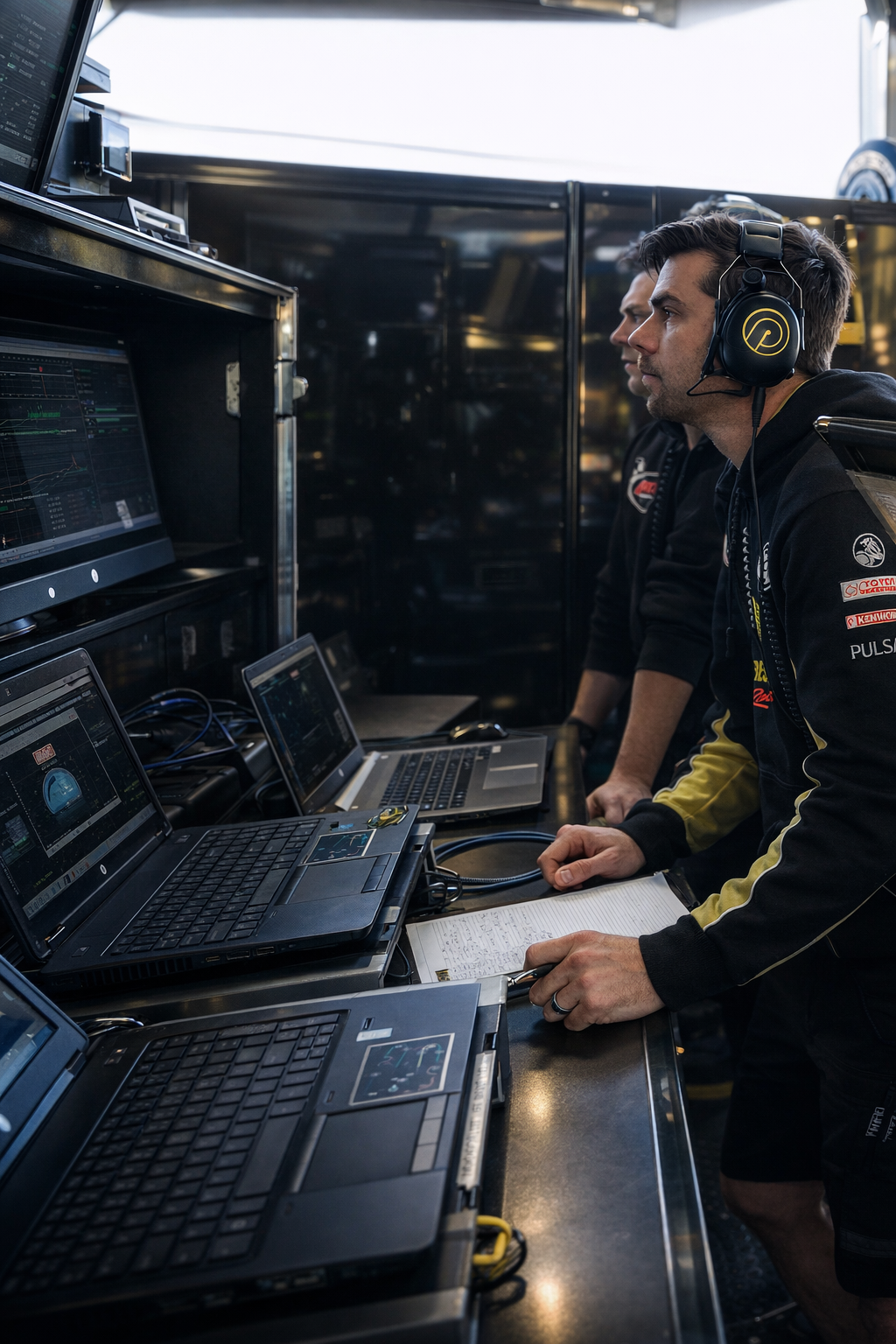
Bryan Richards analysing race data in the Supercars Championship pit garage
Who built this

Bryan Richards spent years learning EFI the hard way, before he had an engineering degree (Honours) or a professional calibration career. He built and tuned his own 13B turbo street car through forums, books, trial and error, and courses that answered some questions but raised even more.

That experience drove everything that followed: a mechanical engineering degree, focused on powertrain and engine controls, race data engineering in the Australian Supercars Championship, marine engine calibration on the supercharged Nizpro 633RR program, and over 15 years experience across Haltech, MoTeC, and Mitsubishi OEM ECU platforms.

He built EFI Mastery as the structured path he wished had existed when he was learning. One system that builds real understanding in the right order, so you don't spend years piecing it together on your own.

What you walk away with

You won't just know what parts you have.
You'll understand why they're there.

The ability to size and select fuel system components, ignition components, and a standalone ECU for any build, based on your own calculations.

A clear understanding of what every major component in your EFI system does, why it was specified, and what happens when it fails or underperforms.

Working knowledge of inputs, outputs, and control strategies that makes you an informed participant in any build or calibration conversation.

The confidence to evaluate recommendations, question assumptions, and make specification decisions on your own terms.

The correct foundation to continue into calibration if your goals grow beyond hardware.

Tools you keep

Fuel System Selection Blueprint
Ignition System Selection Blueprint
ECU Selection Blueprint
Wire Sizing Matrix
Course Summary Workbooks for every course in the Program
Start here

Hardware Competence Program

Stages 0, 1, and 2 · 6 courses included
Founding Student Price
$299 USD
or
3 × $133 USD /month
Regular price after founding spots fill: $397 USD

100 founding spots available. Founding students lock this rate permanently.

  • Engine Fundamentals
  • Engineering Principles in EFI Systems
  • Piston or Rotary Engine Essentials
  • EFI Hardware: Fuel System
  • EFI Hardware: Ignition System
  • ECU Functions & Operation
  • All Stage artifacts and tools
Start the Program. If it's not what you expected, full refund within 30 days.
Is this right for me?
Common questions
Do I need any prior mechanical or electrical experience? +
No. Stage 0 builds your understanding of engine mechanics, engineering principles, and platform-specific architecture from the ground up. No prior technical background is assumed.
Will this teach me to tune? +
No. This Program builds the hardware knowledge and ECU understanding that calibration depends on. If you want to tune, the Calibration Competence Program or EFI Master Program is what you need. This Program gives you the foundation to specify, install, and understand EFI components with confidence.
Does this cover OEM/factory ECUs? +
The focus is on standalone aftermarket ECU systems. OEM ECU architecture is referenced where relevant to build understanding, but the hardware specification and selection content is aimed at standalone platforms.
What if I already have a running car and just need to understand what I have? +
That is exactly what this Program is for. You will learn to evaluate your existing hardware setup, understand what each component does and whether it is appropriate for your application, and have informed conversations with your tuner.

Get notified when doors open.

Join the waitlist for the Hardware Competence Program. No obligation, no spam. You'll be the first to know when founding spots become available.

No spam. Unsubscribe anytime.

You're on the list.

We'll let you know as soon as founding spots open for the Hardware Competence Program.