That's the focus of this article. We're not walking through a platform-specific timing procedure. Instead, we're looking at the reasoning behind ignition timing decisions, starting with combustion phasing and MBT, and finishing with the most common thing that prevents you from reaching it.
Why timing produces torque
When the spark plug fires, combustion doesn't happen instantly. A small flame kernel forms at the plug and develops into a flame front that travels across the combustion chamber, progressively heating and expanding the gases. As this happens, pressure in the cylinder rises.
The torque your engine produces on the power stroke depends on two things. The peak cylinder pressure, and where in the engine cycle that pressure occurs. Peak pressure alone isn't enough. It has to arrive at the right time to be useful.
Think about pushing someone on a swing. Push at exactly the right moment and all of your effort translates into motion. Push too early, while they're still coming towards you, and you're working against their movement. Push too late, after they've already started accelerating away, and the impact of your effort is reduced. Ignition timing works the same way.
Peak pressure alone doesn't produce maximum torque. It's the combination of peak pressure at the right engine position that matters.
The target is to have peak cylinder pressure occur between roughly 14 and 18 degrees of crankshaft rotation after top dead centre (ATDC). At this point, the piston has moved far enough past TDC that the connecting rod geometry provides meaningful leverage on the crankshaft, but not so far that the expanding gases are pushing into a rapidly increasing cylinder volume with diminishing effect.
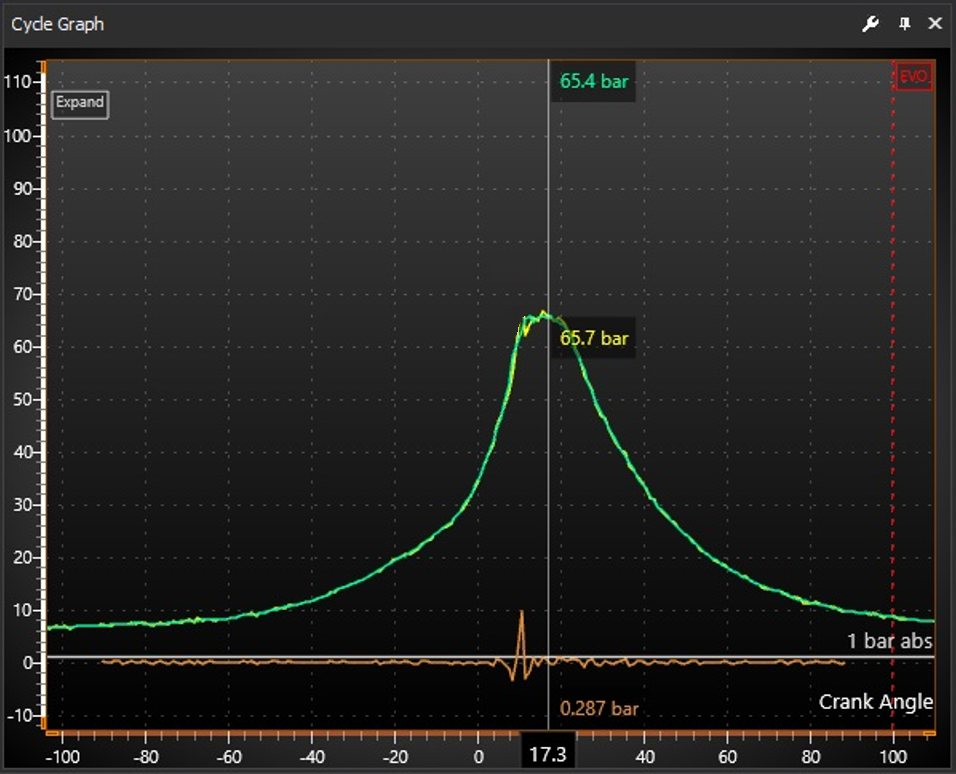
It's worth noting that this window is a practical guideline, not a fixed universal constant. The exact angle where peak pressure produces the most useful work depends on engine geometry, particularly the rod-to-stroke ratio and crank pin leverage characteristics. For most automotive engines, the 14 to 18 degree range holds well, but the optimum can shift a few degrees either way depending on the specific engine design.
This is where the concept of MBT comes in.
Understanding MBT
MBT stands for Minimum spark advance for Best Torque. You'll also see it referred to as Maximum Brake Torque timing. Both terms describe the same thing. It is the least amount of ignition advance, or spark advance, needed to produce maximum torque at a given operating point.
The word "minimum" in the first definition is important. It tells you that the goal isn't to advance timing as far as possible. It's to advance just enough for combustion to develop so that peak pressure lands in that 14 to 18 degree window after TDC. This process of positioning peak pressure at the right point in the cycle is what calibrators refer to as combustion phasing.
If timing is under advanced, the flame front doesn't have enough of a head start. By the time cylinder pressure reaches its peak, the piston has already moved well past the optimal position, and the expanding gases are pushing on a crankshaft that can't make full use of it. If you're tuning on a dyno, this will show as reduced torque.
If timing is over advanced, cylinder pressure peaks too early and a significant portion of the pressure rise occurs while the piston is still completing the compression stroke, effectively working against the engine rather than with it. This also increases peak cylinder pressures unnecessarily and we find that torque drops here too.
At MBT, peak pressure lands right where it needs to, and we get the most torque the engine can produce for that combination of RPM, load, and operating conditions.
MBT timing isn't about maximum advance. It's about just enough advance for peak pressure to arrive at the right point in the cycle.
One practical characteristic of MBT that's useful to understand is that the torque curve is relatively flat within a few degrees either side of the optimum. Being one or two degrees off MBT barely costs you anything measurable. But once you move beyond that window, torque drops off sharply in both directions. This means that chasing the absolute last degree of precision is a lot less important than just making sure you're not way over or under advanced. Under advanced and you leave power and torque on the table and put thermal load into downstream components and the cooling system. Over advanced and you still leave power and torque on the table but have significantly increased knock risk and more pumping losses as the cylinder pressure works negatively on the engine.
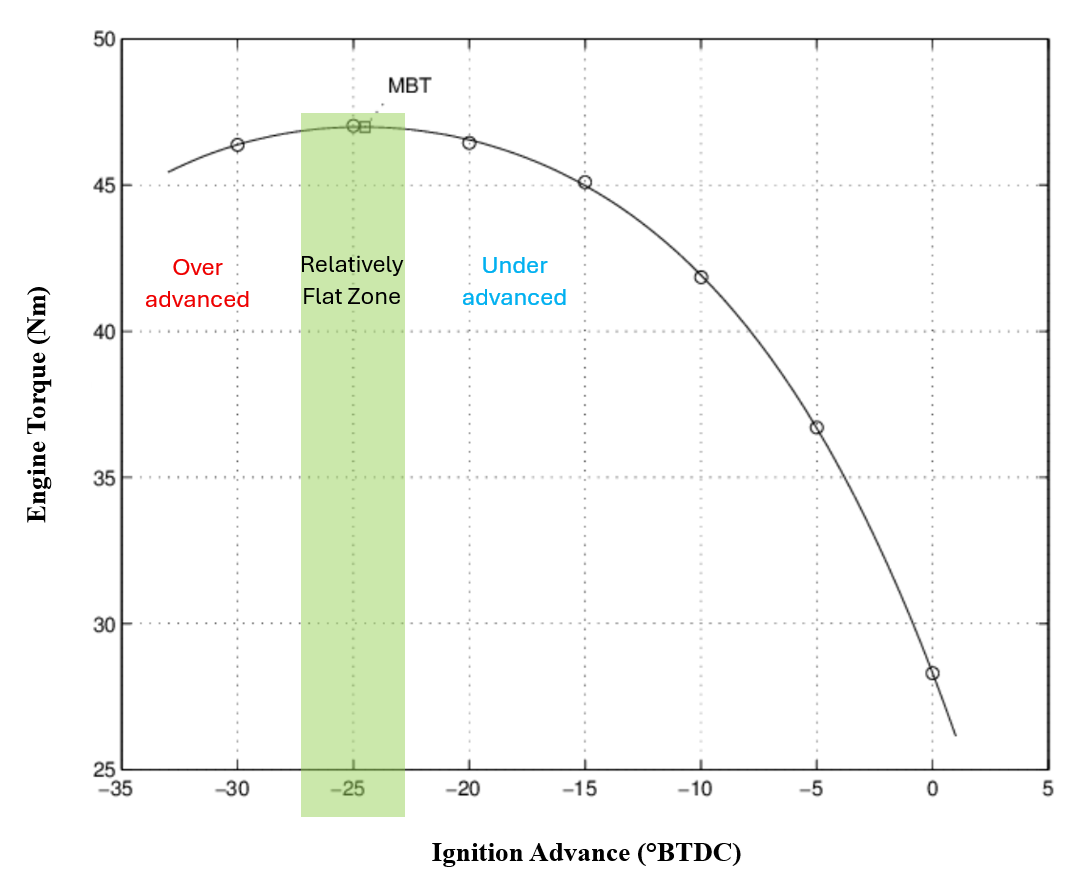
This leads to an important distinction. On many engines, particularly at light to moderate loads, torque will plateau and then start to fall away as you continue to advance timing, without any knock occurring at all. The engine simply passes through MBT. If you're advancing timing until you hear knock and then backing off a couple of degrees, you may think you've found the optimum, but you could already be well past it. This is one of the main reasons that ignition timing should be optimised on a dyno where you can directly observe the torque response to timing changes, rather than relying on knock onset as your only reference.
Why timing has to change with RPM and load
If the target peak pressure position is always 14 to 18 degrees after TDC, and combustion takes a relatively consistent amount of time to complete, then the amount of advance we need has to change as engine speed changes. This is because combustion duration is measured in time, not in degrees of crankshaft rotation.
At 6000 RPM, the crankshaft rotates twice as far in the same amount of time compared to 3000 RPM. If the flame front takes a given amount of time to propagate through the mixture and build to peak pressure, the crankshaft covers far more angular distance at the higher speed during that window. To keep peak pressure landing in the same position, we have to fire the spark plug earlier.
This gives us the first fundamental trend. As RPM increases, MBT timing generally increases.
Engine load affects timing from the other direction. At higher loads, cylinder pressure and temperature are higher, and the charge is denser. This promotes faster flame speed and a shorter overall burn. Because pressure builds more quickly, peak pressure arrives sooner. To prevent it from peaking too early, we reduce the advance.
This gives us the second trend. As engine load increases, MBT timing generally decreases.
Combustion takes time, not degrees. RPM determines how far the crank rotates during that time. Load determines how quickly the mixture burns.
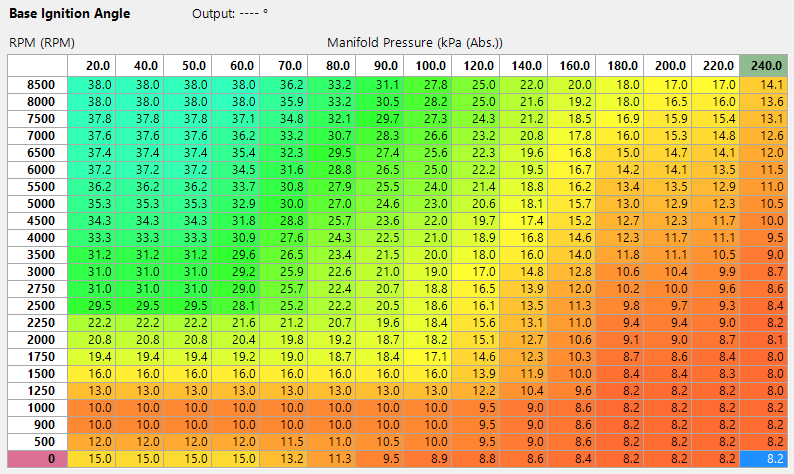
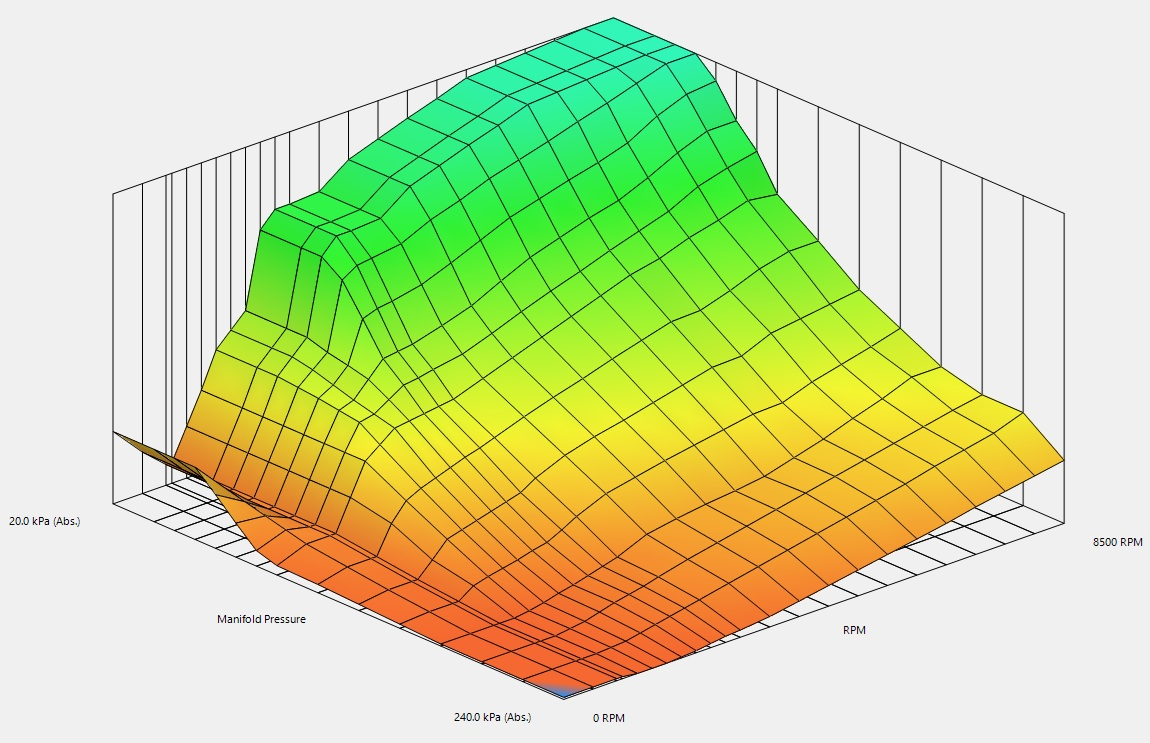
These two trends shape the ignition timing table. You'll typically see timing values increase as you move up the RPM axis and decrease as you move along the load axis towards wide open throttle. The surface should be smooth and progressive, reflecting the underlying physics of combustion phasing.
What stops you reaching MBT
If MBT is the timing that produces best torque, the obvious question is why not just set every cell in the timing table to MBT and call it a day.
At light loads and part throttle, you often can. Cylinder pressures are relatively low, combustion temperatures are manageable, and the engine will happily operate at MBT across a wide range of the map.
At higher loads, particularly at wide open throttle, the picture changes. As cylinder pressures rise, the conditions inside the combustion chamber become more extreme. Temperatures and pressures in the unburned portion of the air/fuel mixture ahead of the flame front, called the end-gas, can increase to the point where it spontaneously ignites before the flame front reaches it.
This is knock, sometimes called pinging because of the metallic sound it produces as pressure waves reverberate inside the cylinder.
Knock is a form of abnormal combustion that produces rapid, uncontrolled pressure spikes in the cylinder. It's damaging to engine components and, beyond a certain severity, can cause catastrophic failure. The important thing for this discussion is that knock typically appears as you advance timing towards MBT under high load conditions. You're chasing the torque, but the engine's knock threshold gets in the way first.
When knock prevents you from reaching MBT, the maximum timing you can safely run is called Knock Limited Spark Advance, or KLSA. This becomes your effective timing ceiling for that operating point.
Most engines are knock limited at wide open throttle. KLSA, not MBT, defines the maximum usable timing under high load.
The gap between KLSA and MBT represents lost potential. Every degree that KLSA falls short of MBT is torque and power you're leaving on the table. This is why fuel octane, intake air temperatures, compression ratio, charge cooling, and a range of other factors matter so much for performance calibration. They all influence where the knock limit sits relative to MBT.
Closing that gap, safely, is one of the core objectives of ignition timing calibration.
Understanding what knock actually is, what causes it, and how to detect and manage it is the next step. That's the subject of the next article.
Key points
- Ignition timing determines when the spark plug fires, which controls where peak cylinder pressure occurs during the power stroke.
- MBT is the timing value that positions peak pressure at roughly 14 to 18 degrees after TDC, where it produces maximum torque. The exact optimum depends on engine geometry, but this range holds for most automotive engines.
- Torque is relatively flat within a few degrees of MBT, then drops off sharply. Being close matters more than being exact, but being significantly off is costly in both directions.
- On many engines, torque will peak and fall away before knock appears. Advancing timing until knock and backing off is not the same as finding MBT. Use a dyno to observe the torque response directly.
- Combustion takes time, not crankshaft degrees. Higher RPM requires more advance to compensate for the crank rotating further during the burn. Higher load requires less advance because the denser charge burns faster.
- At light loads, MBT is usually achievable. At high loads, knock typically prevents you from reaching it.
- KLSA, or Knock Limited Spark Advance, becomes the effective timing limit when knock appears before MBT is reached.
- The gap between KLSA and MBT is the performance left on the table. Reducing that gap is a core calibration objective.
Related Resources
Combustion phasing, MBT, and knock management are covered in depth in Stage 3 of the Calibration Competence and EFI Master Programs. Take the free assessment to find out which one fits your goals.
Find Your ProgramGet notified of new articles
One article per week on EFI fundamentals, calibration principles, and diagnostic thinking. No spam.
You're subscribed. We'll let you know when new articles are published.