Calibration Competence Program

You want to tune your own car.
The path to get there shouldn't be this hard to find.

Know what you're looking for? Skip to the Program

You've decided you want to do this yourself. Not because it's cheaper than paying a tuner, but because you want to understand what's happening inside your engine and have the skills to control it.

So you started looking. And you found plenty of information. Forum threads, YouTube videos, courses, manufacturer webinars. No shortage of content. But the more you consume, the less clear the picture gets. Everyone explains their piece, but nobody shows you how the pieces connect or what order to tackle them in.

You ask about AFR targets and get fifteen different answers, all confident, none explaining why. You watch someone walk through a tune and it makes sense until your engine does something different. You might have finished a course and walked away knowing more facts but still not feeling like you could sit down and do a full calibration from scratch.

The motivation is there. The effort is there. What's missing isn't more information. It's structure connecting the pieces, decision logic for when things don't match the textbook, and a clear process from first start to verified tune.

Why you're stuck

The problem isn't how much you know.
It's how you learned it.

Every YouTube video gives you a fragment. Every forum thread gives you an opinion. Every course you've taken probably taught you what values to enter, but not why those values are correct.

So when your engine does something that doesn't match the example, you're stuck. You don't have a framework to fall back on. You have a collection of isolated facts with no structure connecting them.

That's not a failing on your part. It's a gap in how this industry teaches. Most courses are built around topics, not around a development path. They teach you the pieces but never show you how they fit together, or what order to learn them in.

The result is the same for almost everyone: you finish a course and still don't feel ready to do a full calibration from scratch.

The Calibration Competence Program doesn't give you more information. It gives you a structured path from engine fundamentals through to a completed, verified tune. Every Stage builds on the last. Every concept is taught in the order you need it. And every decision is framed around why, so you can adapt it to any engine and any standalone ECU platform.

The way forward

Five Stages. From engine principles
to a completed calibration.

This isn't a syllabus. It's a progression. Each Stage is a shift in what you can do, not just what you know. Five Stages, each one building directly on the last.

Stage 0
Foundations
You understand how your engine actually works and why every system exists.
+

In Stage 0, you will develop the core knowledge of engine mechanics, engineering principles, and platform-specific engine design that underpins the entire Roadmap. You will study how engines work, how pressure, heat transfer, and electrical principles apply to EFI systems, and then go deeper into your specific engine platform through the piston or rotary fork. This is where you build your solid foundation for the Stages that follow.

Courses Included

  • Engine Fundamentals
  • Engineering Principles in EFI Systems
  • Piston Engine Essentials or Rotary Engine Essentials

Key Topics

  • Engine operating principles
  • Pressure, heat transfer, and electrical fundamentals
  • Platform-specific engine architecture

"I don't know what I don't know" "I have the foundation."

Stage 2
ECU Architecture & Control
You understand what your ECU is doing with sensor data and why load strategy matters.
+

In Stage 2, you will build a clear picture of what is actually happening inside your ECU. You will start with inputs, learning what each sensor is measuring and how the ECU uses that information to calculate engine load. From there you will work through the three main load calculation strategies, what makes each one suited to a particular application, and where the trade-offs lie. You will then move into control theory, covering the difference between open and closed loop control and what PID control means in practice, not just in theory. By the end of this Stage, you will know how to evaluate and select a standalone ECU for your specific build and how to plan your inputs and outputs before a single wire is connected.

Course Included

  • ECU Functions & Operation

Key Topics

  • Sensor inputs and load calculation
  • Speed-density, alpha-N, and MAF strategies
  • Open loop, closed loop, and PID control
  • ECU selection and I/O planning

"I don't understand what the ECU is doing" "I understand the control system."

Stage 3
Fuel & Combustion
You can set correct lambda targets and ignition timing for any operating condition and manage knock with confidence.
+

In Stage 3, you will develop a solid understanding of the combustion process, fuel properties, and air-fuel ratio targeting that sits at the core of any calibration. You will learn how ignition timing interacts with combustion phasing and why MBT matters. You will also cover how knock occurs and what causes it, so that when you encounter it during calibration you know exactly what the engine is telling you. Three structured decision-making tools are introduced in this Stage: the Lambda Selection Matrix, the Knock Control Matrix, and the Fuel Selection Matrix. You will use all three in every calibration from here on.

Course Included

  • Fuels, Combustion & AFR Essentials

Key Topics

  • Combustion phasing and MBT
  • Lambda targeting by operating condition
  • Knock: causes, detection, and management
  • Fuel properties and selection

"I don't know what numbers to target" "I know why these targets are correct."

Stage 4
Data & Analysis
Your calibration decisions are driven by evidence, not instinct.
+

In Stage 4, you will develop the analytical skills and session discipline that turn raw data into confident calibration decisions. You will learn how to set up sensors correctly, manage logging rates, and apply a consistent methodology across any ECU or logging platform, with worked examples in MoTeC i2, Haltech Datalog Viewer, and MegaLog Viewer HD. The final module puts the process to work through case studies where you analyse real logs and identify the root cause of each issue before the answer is revealed. It is the difference between a calibrator who reads data and one who understands what it is telling them.

Course Included

  • Data Acquisition & Analysis

Key Topics

  • Sensor setup and logging methodology
  • Multi-platform log analysis
  • Root cause diagnostic case studies
  • Session discipline and repeatability

"I'm guessing" "I'm making decisions based on data."

Stage 5
EFI Calibration
You can execute a complete calibration from setup through verification and produce a validated, road-ready tune.
+

In Stage 5, you will work through the complete standalone ECU calibration process using a structured three-phase approach: setup, calibration, and verification. In the setup phase, you will configure your ECU, populate correct starting values, and prepare the engine for its first start. In the calibration phase, you will build your fuel and ignition maps methodically using steady-state and ramp run techniques, calibrate compensation tables across operating conditions, and learn to detect and manage knock with confidence. The course also covers Variable Cam Timing, Drive By Wire, and Flex Fuel calibration, giving you the skills to handle the full range of systems found on modern standalone platforms. In the verification phase, you will validate your calibration through structured road testing and confirm it meets defined completion criteria. You will finish with a fully functional, road-ready tune and a repeatable calibration workflow you can apply to any engine.

Course Included

  • Calibration: Standalone ECU

Key Topics

  • Standalone ECU calibration (NA, supercharged, turbocharged*)
  • Flex Fuel calibration
  • Drive By Wire and Variable Cam Timing
  • Compensation tables
  • Structured verification and road testing

*Turbocharged calibration is completed at wastegate spring pressure. Electronic boost control is covered in Stage 6.

"I don't trust myself to tune it" "I have a validated process and a verified result."

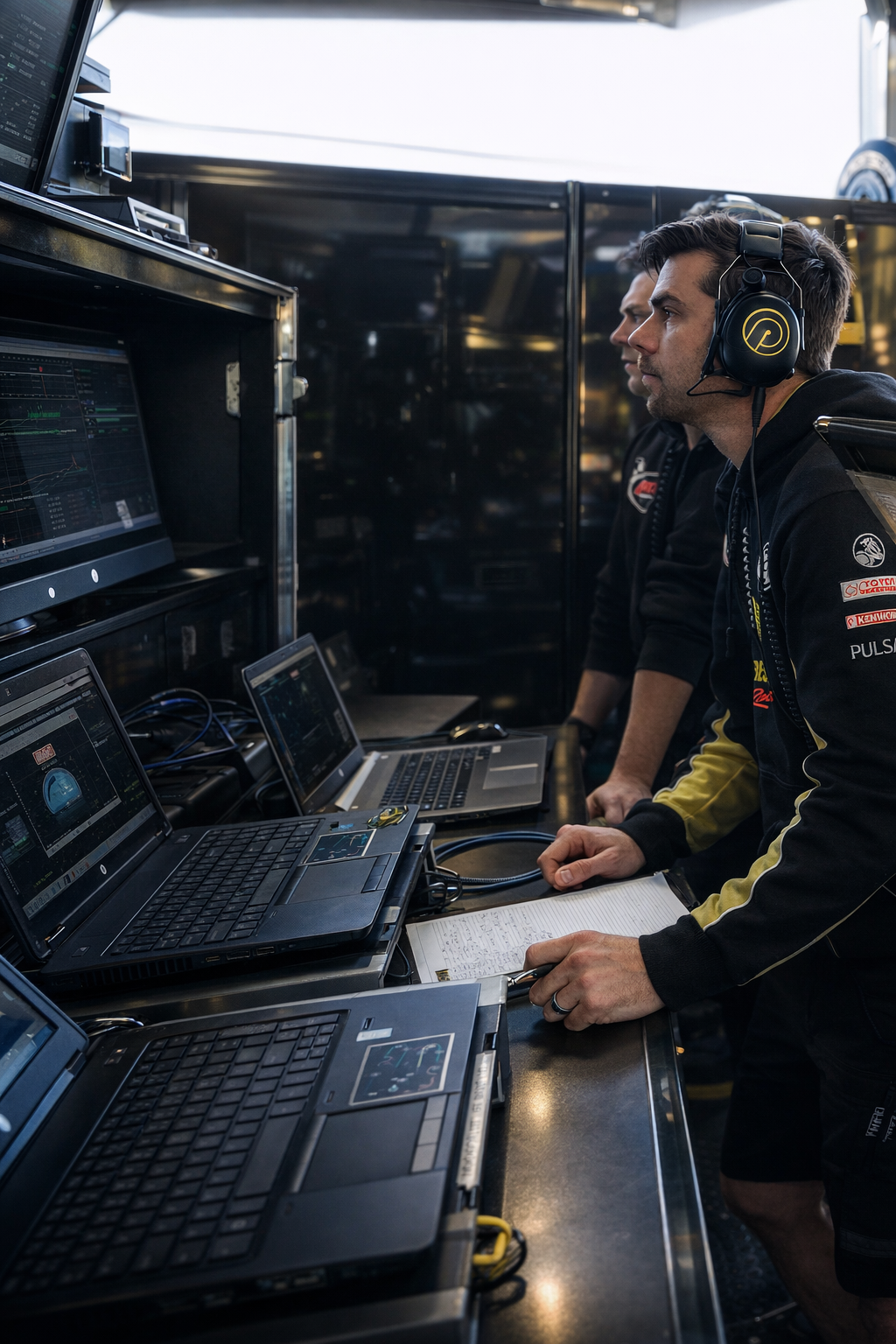
Bryan Richards analysing race data in the Supercars Championship pit garage
Who built this

Bryan Richards spent years learning EFI the hard way, before he had an engineering degree (Honours) or a professional calibration career. He built and tuned his own 13B turbo street car through forums, books, trial and error, and courses that answered some questions but raised even more.

That experience drove everything that followed: a mechanical engineering degree, focused on powertrain and engine controls, race data engineering in the Australian Supercars Championship, marine engine calibration on the supercharged Nizpro 633RR program, and over 15 years experience across Haltech, MoTeC, and Mitsubishi OEM ECU platforms.

He built EFI Mastery as the structured path he wished had existed when he was learning. One system that builds real understanding in the right order, so you don't spend years piecing it together on your own.

What you walk away with

You won't just finish a tune.
You'll know how to do the next one.

A fully functional, road-ready tune on a naturally aspirated or forced induction engine at controlled boost.

A repeatable calibration workflow you can apply to any engine on any standalone ECU platform.

The ability to read datalogs, set correct lambda targets and ignition timing, and make calibration decisions based on evidence.

The diagnostic framework to handle problems you haven't seen before, because you understand why, not just what.

Confidence to open the ECU software, make changes, and know exactly what you're doing.

Tools you keep

Standalone ECU Calibration Workflow
Compensation Table Matrix
Plus all artifacts from prerequisite Stages (Lambda Selection Matrix, Knock Control Matrix, Fuel Selection Matrix, and more)
Start here

Calibration Competence Program

Stages 0, 2, 3, 4, and 5 · 6 courses included
Founding Student Price
$749 USD
or
3 × $333 USD /month
Regular price after founding spots fill: $997 USD

100 founding spots available. Founding students lock this rate permanently.

  • Engine Fundamentals
  • Engineering Principles in EFI Systems
  • Piston or Rotary Engine Essentials
  • ECU Functions & Operation
  • Fuels, Combustion & AFR Essentials
  • Data Acquisition & Analysis
  • Calibration: Standalone ECU
  • All Stage artifacts and tools
Start the Program. If it's not what you expected, full refund within 30 days.
Is this right for me?
Common questions
What ECU platforms does this cover? +
The course teaches principles and workflows that apply to any standalone ECU. Worked examples use Haltech, MoTeC, and Megasquirt, but the focus is on understanding why, not memorising menus. If you can navigate your ECU software, you can apply what you learn here.
Do I need a dyno? +
No. The calibration workflow covers both dyno and road tuning approaches. You will learn how to verify your tune in whatever environment you have access to.
Do I need to complete the Stages in order? +
Yes. Each Stage builds directly on the one before it. The structure is deliberate. Skipping ahead creates exactly the kind of gaps this Program is designed to close.
What if I already understand hardware and just want to learn calibration? +
The Calibration Competence Program includes Stages 0 and 2 (fundamentals and ECU architecture) because they directly feed into the calibration workflow. If you are confident in those areas, you will move through them quickly, but they ensure no gaps in the foundation.

Get notified when doors open.

Join the waitlist for the Calibration Competence Program. No obligation, no spam. You'll be the first to know when founding spots become available.

No spam. Unsubscribe anytime.

You're on the list.

We'll let you know as soon as founding spots open for the Calibration Competence Program.