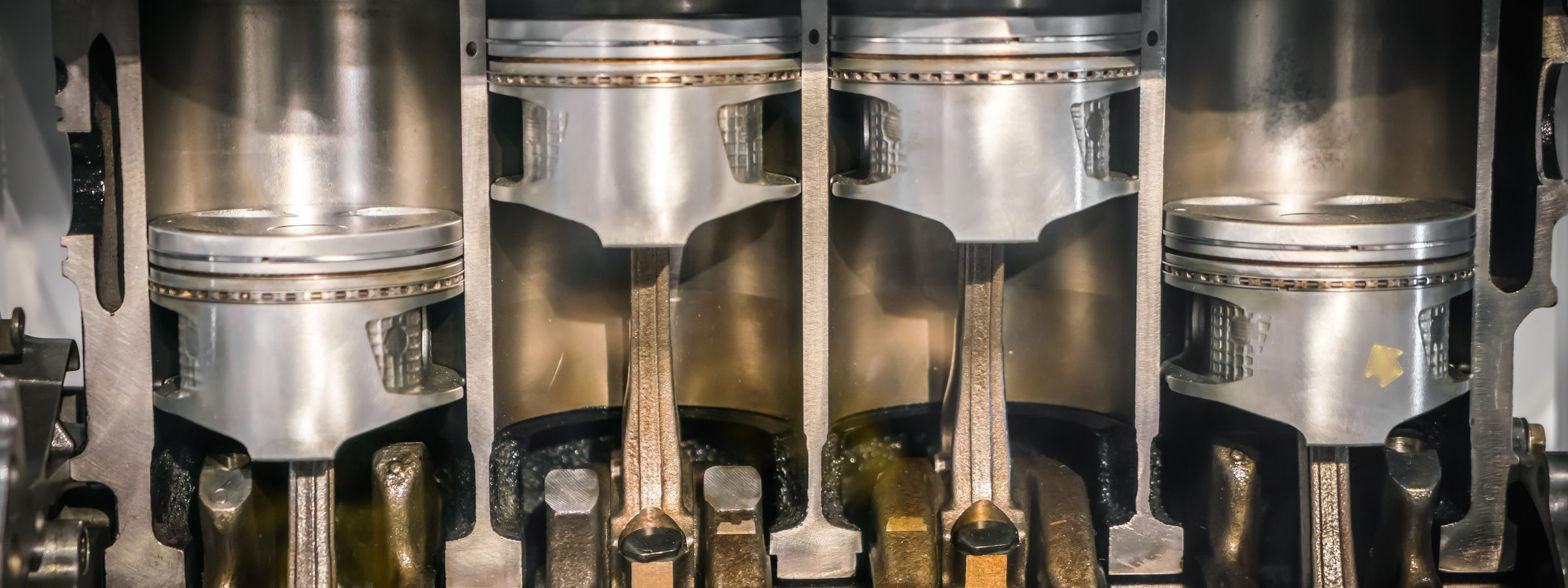
The thing to keep in mind, though, is that compression ratio tells us what to expect from an engine, not what's actually happening inside the cylinder. Think of it more like an indicator of what to expect, but not a guarantee. What any given engine really responds to is the pressure and temperature history of the intake charge, and compression ratio is only one of the things that shapes that. So let's take a look at what the number genuinely tells us, where it's less certain, and why it's still the first thing worth knowing about an engine.
What the number actually tells us
The compression ratio is defined as the maximum volume of a cylinder divided by the minimum volume, and it describes how much we squeeze the charge before the combustion event. With the piston at the bottom of its stroke the cylinder is at its maximum volume, and as the piston travels up to the top of the stroke that volume is reduced to a minimum. At 10 to 1, the charge ends up in a tenth of the space it started in.
That compression is where the efficiency comes from. The more we compress the charge before we light it, the longer the expansion we get on the way back down, and a longer expansion lets us pull more useful work out of the same burn. So, all else being equal, a higher compression ratio gives us a more efficient engine, and that efficiency means we can extract more usable power from the same fuel. It's exactly why direct injection has become so common in modern engines, since injecting the fuel straight into the cylinder cools the charge and lets manufacturers run a higher static compression ratio on the same pump fuel than they could with port injection.
Higher is better, up to a point
There are a couple of things that stop us just winding the compression ratio up without limit. The first is that the efficiency gains start to taper off. Efficiency climbs quickly through the lower ratios, but the curve flattens out once we're past about 10 to 1, so each extra point of compression improves efficiency less than the one before it. The curve flattens partly because the maths behind theoretical efficiency gives diminishing returns, where each extra point of compression is worth less than the last, and partly because real engines lose more to heat as the ratio increases. As the clearance volume gets smaller, the area represented by the piston crown and head face stays approximately the same, so the surface-to-volume ratio increases and more of the combustion heat ends up soaked into the chamber walls. That loss of heat matters because it's fuel energy carried off into the coolant instead of driving combustion pressures higher to push the piston down the bore. It's work we were after and didn't get, eating into the very efficiency we raised the compression ratio for in the first place. Crevice losses and a little more friction add to it as well, to a lesser degree.
The other main reason we can't just continue to increase compression ratio higher and higher is auto-ignition.
Compression ratio and efficiency move together, but not in proportion to one another. The efficiency gains tail off as the ratio climbs, and knock usually shows up well before we have an optimised compression ratio.
More compression, less knock headroom
Increasing the compression ratio does give rise to improved expansion ratios, but it also raises the pressure and temperature of the intake charge in the cylinder, both before and after the spark plug has fired. Once we light the mixture off with the spark plug, the unburned mixture sitting ahead of the flame, the end-gas, is already hotter and under higher pressure, which means for the same fuel with the same knock resistance, it moves us closer to the knock limit of the engine. So compression ratio is one of the main variables behind how knock prone an engine is.
Where we see it show up on the dyno is with how much ignition timing we can run. As we advance the timing toward MBT, most engines will knock before they get there, and this becomes our knock limited spark advance, or KLSA. Raise the compression ratio and we've raised the pressure and temperature history of the end-gas, so the engine knocks at less ignition advance than it would at a lower compression ratio. The KLSA moves further away from MBT, the engine is more knock limited than it was, and we're left unable to give it all the timing it actually wants.
There are ways that we can get our knock margin back, however. A fuel's octane rating is really just a measure of how much compression (temperature and pressure) it will take before it knocks, found by running it on a test engine and winding the compression up until it does. So compression ratio and fuel combined are two sides of the same decision, and pushing one means we need more of the other. It's why a typical naturally aspirated engine on pump fuel tends to land somewhere between 10 and 12 to 1, and why those numbers can climb as high as 16 to 1 in special applications like high-end performance car and motorbike engines, which are running the fuel and the chamber design to support it. A forced induction engine, on the other hand, usually sits lower, in the 8 to 10 range, to account for the extra pressure and temperature the turbo or supercharger is already adding before compression even starts. The specific numbers matter less than the general trend here, which is that naturally aspirated engines tend to run higher compression ratios, forced induction engines run lower, and the fuel has to suit whichever one we've got. High ethanol blends bring many advantages when it comes to knock resistance, so these can often be used in higher compression ratio engines that also run forced induction, but this is a decision that needs careful planning of both the hardware and calibration to bring it all together.
Compression ratio also steers the decisions we make once we're on the dyno. On a turbocharged or supercharged engine the boost is piling cylinder pressure on top of whatever the compression ratio already builds, and both are drawing on the same knock margin. So a higher compression ratio usually means we'll be targeting less boost to keep the combination in check, and the ratio gives us a feel up front for how much room boost has to work with before we expect to run into the KLSA.
The way the fuel is delivered shifts that picture too. A direct injected engine sprays fuel straight into the cylinder, where it evaporates and cools the charge from the inside, and we touched on how that lets manufacturers lift the compression ratio. For us as tuners, that same cooling means a direct injected engine carries more knock margin at a given compression ratio than a port injected one, where a good deal of the fuel evaporates off the port wall and valve before it ever reaches the cylinder. So the same number on the spec sheet tells a slightly different story depending on how the fuel is delivered, and a direct injected engine tends to be the more forgiving of the two to tune.
Compression ratio doesn't cause knock on its own. It moves the engine closer to its knock limit, and the fuel decides how much room is left.
Static compression ratio isn't the whole picture
This is where relying on that single number too much starts to catch us out. The static compression ratio is worked out with the piston at the bottom of its stroke, but a lot of the time the charge doesn't actually begin being compressed there. Nothing compresses until the intake valve closes and the chamber is sealed off, and on most engines that happens a fair way back up from the bottom of the stroke. So the compression the charge really sees, which we call the dynamic or effective compression ratio, is often lower than the static figure, and it's the cam timing that sets it rather than pure geometry on its own.
That matters more on an engine with variable cam timing, because the point where the intake valve closes moves around as the engine runs. The effective compression ratio shifts with it, which turns it from a fixed feature of the build into something we can actually influence in our cam timing tables. On a fixed-cam engine the locked-in cam timing decides this for us and that's pretty much that. Either way, you won't find effective compression ratio printed on a spec sheet anywhere, so it's just something to keep in mind, and it's another one of the ways that variable cam timing can be used to influence what is going on in the cylinder at any given operating point.
What's important to remember here is that the engine actually responds to the whole pressure and temperature history of the charge, from the moment the intake valve traps it through to the moment the plug fires and combustion completes. Static compression ratio feeds into that, but so does the manifold pressure, the intake air temperature, and the charge cooling as the fuel evaporates, which is part of why a high-ethanol blend buys back so much knock margin. The residual exhaust gas left from the last cycle plays its part too, and so does the cam timing we just talked about. That pressure and temperature history is what we're really managing as tuners, with whatever levers we have available, from ignition timing and fuel choice, through to boost levels and cam timing. The compression ratio gives us a first read on what that history is likely to look like, but it doesn't tell us everything in advance.
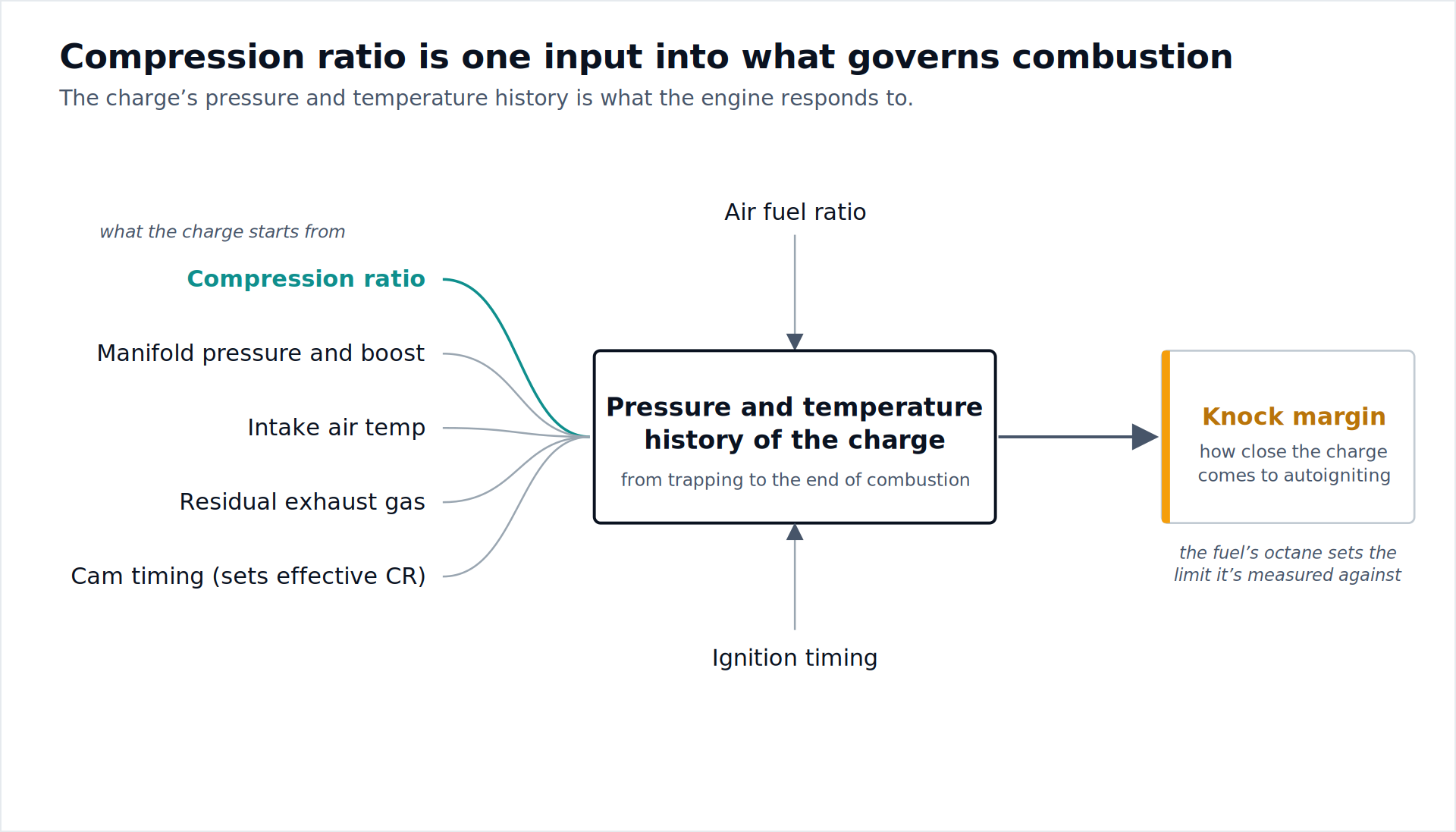
Static compression ratio tells us what to expect from an engine, but the actual pressure and temperature history of the charge, right up to the end of combustion, is what determines what we're actually going to be dealing with.
Why it's still the first number to know
None of this pushes compression ratio off the top of the list. It's still the first number worth knowing about any engine, because it gives us a starting point for everything that follows. A high static ratio is a heads-up to expect an efficient engine that'll be particular about its fuel, quick to run short on timing headroom, and, if it's force fed, happier with more conservative boost. A low compression ratio tells us there's some knock margin to work with, and probably a bit of efficiency still left on the table. Before we've logged a single pull or opened a table, the compression ratio has already sketched out the kind of engine we're dealing with and where the hard work is likely to be. The trick is treating it as the opening read, and not the final word.
Key points
- The compression ratio is the maximum cylinder volume divided by the minimum, and it describes how far the charge is squeezed before combustion. It's fixed when the engine is built.
- A higher compression ratio improves efficiency, letting the engine pull more usable work out of the same fuel. The gains tail off past roughly 10 to 1, and real engines fall a little short of the ideal efficiency, mostly through heat lost as the chamber's surface-to-volume ratio increases.
- A higher compression ratio also raises the pressure and temperature in the cylinder, so the end-gas is closer to autoigniting. The engine reaches KLSA at less advance and sits further from MBT for a given fuel.
- Compression ratio and fuel octane are two sides of the same decision. Raise the compression and we need more octane to hold the same knock margin.
- There's no fixed rule for the compression ratio an engine runs. It comes down to the fuel, the chamber design, and whether it's force fed. Naturally aspirated engines on pump fuel tend to sit around 10 to 12 to 1, special applications higher again on the right fuel, and forced induction engines lower to account for the boost.
- On the dyno, a higher compression ratio usually means lower boost targets, since boost and compression both erode our knock margin. And because a direct injected engine cools the charge from the inside, it tends to tolerate more compression, or hand back more margin at the same ratio, than a port injected one.
- Static compression ratio overstates what the charge actually sees, because real compression only starts at intake valve closing. The effective ratio is set by the cam timing, and with variable cam timing it becomes a lever we can use to influence the temperature and pressure history of the intake charge.
- What ultimately governs combustion is the whole pressure and temperature history of the charge. Compression ratio is our first read on what that might look like, but it's not the full picture.
Related Resources
Compression ratio is one of the first things you read off an engine, but working out what it really means for your calibration, alongside the charge temperature and pressure history that actually governs combustion, is a skill you build through structured practice. Stage 3 of the Calibration Competence and EFI Master Programs develops the combustion reasoning behind it, through a structured progression with depth that carries over to engines and fuels you haven't worked on before. If you're not sure which one fits your goals, do the free assessment and it'll point you in the right direction.
Find Your ProgramGet notified of new articles
One article per week on EFI fundamentals, calibration principles, and diagnostic thinking. No spam.
You're subscribed. We'll let you know when new articles are published.