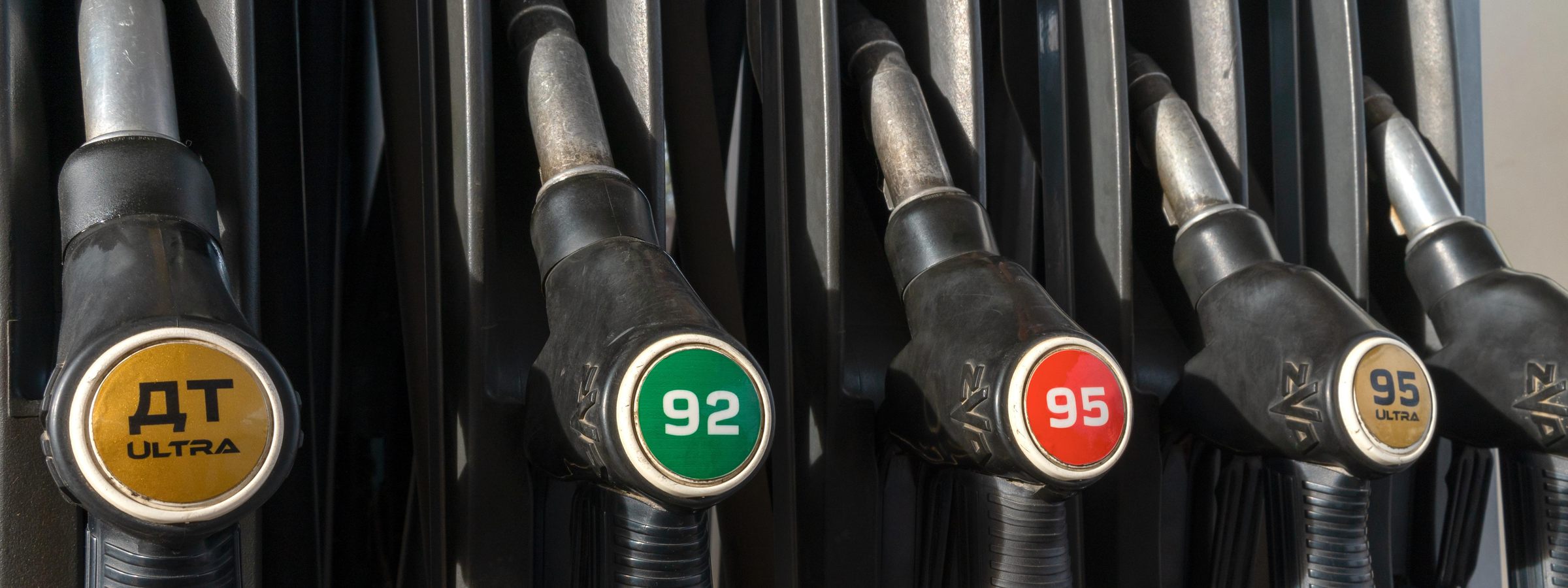
Octane rating is the one fuel property nearly everyone recognizes, because it's printed right there at the pump every time you fill up. It's also one of the easiest to misread. The number is both real and useful, but all it really tells you is how the fuel held up in a standardized lab test, on one specific engine, under fixed conditions which were set decades ago. It's not a fixed or guaranteed level of knock resistance when compared to another fuel type. How much knock resistance you actually get depends on your engine and the conditions it's running in. And with ethanol blends, the gap between what the test measured and what your engine actually sees gets wider still. An octane rating is only useful within a fuel type, so 98 RON gasoline is much the same each time, but 98 RON achieved via an ethanol blend could be something altogether different when run in your particular engine.
In this article we're going to work through what an octane rating actually measures, why two fuels with the same number can knock differently in the same engine, and why ethanol blends tend to behave better than their rating suggests. We'll be focusing more on the reasoning than the chemistry, to give you practical takeaways that you can keep in mind when selecting a fuel to run. The goal is to read a fuel rating for what it is, which is a guide rather than a guarantee.
What an octane rating actually measures
Octane rating is a standardized measure of a fuel's resistance to knock. The higher the number, the more the fuel can tolerate the high temperatures and pressures that lead to autoignition or 'knock'.
That number isn't something you calculate on paper. It comes from running the fuel in a single-cylinder test engine with a variable compression ratio and comparing how it knocks against a reference fuel. The reference is a blend of two pure hydrocarbons, iso-octane, rated 100, and n-heptane, rated 0. If a sample fuel knocks at the same intensity as a blend of 95% iso-octane and 5% n-heptane, it's rated 95.
There are two standard versions of this test, and the difference between them is the whole point of this article. The Research Octane Number, or RON, runs the engine under milder conditions, lower speed and a cooler intake. The Motor Octane Number, or MON, runs the same engine harder, faster, and hotter, and is considered a more severe test. Because MON conditions push the fuel closer to its limit, the MON number is almost always lower, typically by 8 to 12 numbers for pump gasoline.
RON and MON aren't two measures of the same thing. They're the same fuel tested under two different levels of severity, and the gap between them is the part most people skip over.
There's one obvious limitation with the original tests. The reference scale runs from 0 to 100, but plenty of fuels, including ethanol blends and the old leaded race fuels, resist knock better than pure iso-octane. To rate those, the tests use secondary reference fuels that can reach higher than 100, historically lead-based iso-octane and toluene blends, so the scale can extend above its original ceiling. That's why you'll see fuels quoted at 102 or 108 even though iso-octane itself sits at 100.
RON, MON, and AKI, and why the pump label depends on where you are
Which number ends up on the pump depends on where you live. Most of the world posts RON. The US, Canada, and Brazil post something called the Anti-Knock Index, or AKI, which is the average of the RON and MON for that fuel, often written as (R+M)/2.
This matters when you compare fuels across regions or read older material. A fuel posted as 98 RON and one posted as 93 AKI can be the same fuel. AKI sits lower because it factors in the harsher MON result. AKI is an average that was chosen in an attempt to better represent what a typical engine of the era experienced on the road in real-world conditions.
So the first thing to settle is which scale you're reading. The more useful question, though, is what the two underlying numbers are doing, because the single posted figure hides some interesting fuel characteristics.
Octane sensitivity, the gap that tells you how much to trust the number
The difference between a fuel's RON and its MON has a name. It's called octane sensitivity, and it's worth understanding because it tells you how much a fuel's knock resistance changes as the operating conditions change.
A fuel with low sensitivity means its RON and MON are close together, and so its behavior is fairly stable across varying conditions. A fuel with high sensitivity has a wide gap between RON and MON, which means its knock resistance changes a lot depending on how severe the conditions get.
Here's why that's more useful than the headline pump number. Take two example fuels. One is 98 RON, 88 MON, giving a sensitivity of 10. The other is 103 RON, 83 MON, a sensitivity of 20. AKI in both cases is 93. If you only look at the RON value the second fuel looks like the better choice, and looking at AKI there is seemingly no difference. But as conditions get more severe and both move toward their MON rated behavior, the first fuel remains more resistant to autoignition because its RON and MON sit closer together. Which one is actually better depends on the specific operating conditions that engine will see, how the fuel is delivered, and the fuel composition, and that's the next piece of the puzzle we're going to look at.
Octane sensitivity is the gap between RON and MON. It tells you how condition-dependent a fuel's knock resistance is, which is exactly what a single number can't tell you.
Why your engine isn't the test engine
The RON and MON tests each examine the fuel under one fixed set of conditions. Real engines don't sit at either of those points. They sit somewhere along the line between them, and which end they sit closer to depends on the engine and where in its map you're operating.
Conditions that push your engine toward the harsher, MON-like end are the ones we've covered in a previous article (variables that move the knock threshold), and they come down to higher charge and component temperatures: high intake air temperatures, heat-soaked components, and the heat that builds under sustained high load. Under those conditions, a high-sensitivity fuel gives up more of its advantage, and the milder RON number on its own oversells what you've got.
Where this tends to show up in reality is where you might be comfortably clear of knock on a cool morning, but can be much closer to the edge of knock after a hot soak, in summer traffic, or a few high load dyno pulls on an already heat-soaked engine. The fuel in the tank didn't change. The conditions moved it toward its MON behavior, and the more sensitive the fuel, the further it moves.
Modern engines complicate this further. The two tests were defined decades ago, before the widespread use of turbocharging, direct injection, and before high compression ratios were common. Those technologies push conditions inside the cylinder into a region neither test really represents well. Modern engines run high pressure but a relatively cool charge. There, a high-sensitivity fuel can resist knock beyond what its RON would lead you to expect. It's one reason ethanol blends, which tend to have high sensitivity, often perform better on a modern boosted or direct-injected engine than their rating predicts.
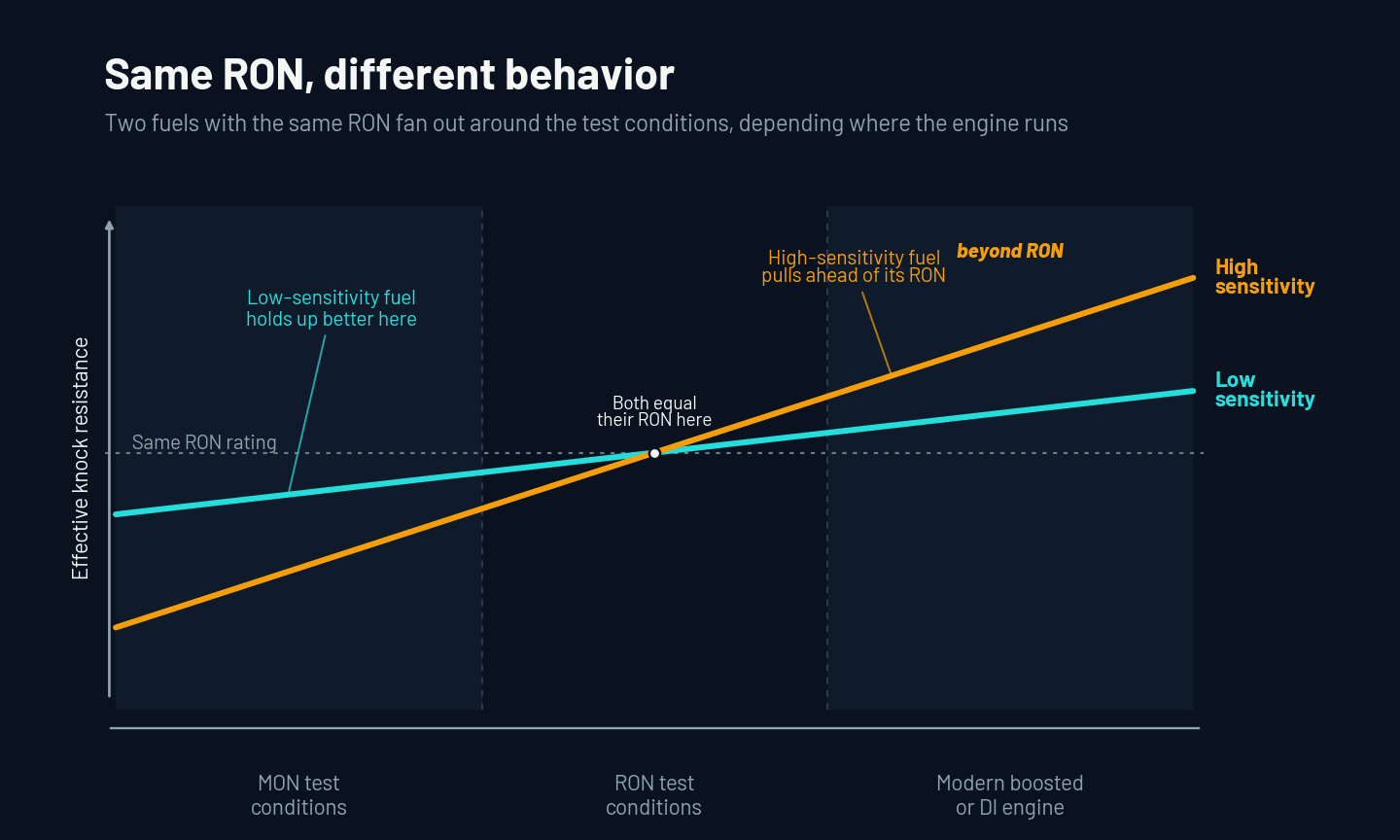
In a modern boosted or direct-injected engine, a fuel with higher sensitivity can often resist knock beyond what its RON number suggests.
The takeaway isn't to memorize which fuel wins where. It's to stop treating the posted number as a fixed property your engine inherits. The number tells you how the fuel behaved at one or two reference points. Your engine decides which of those points it's closest to. That's why you need to be careful when switching between fuels that look identically rated.
The charge-cooling number hidden in ethanol's RON
There's one more reason an ethanol blend's rating can mislead you, and it's specific to how the octane test is run.
The test engine is carbureted, so the fuel is mixed into the air upstream and the two are inducted together, with the intake air temperature set before that mixing happens. With gasoline, the fuel has effectively all flashed to vapor before it reaches the cylinder. With an ethanol blend it hasn't, because ethanol's high latent heat of vaporization means a good deal of it is still evaporating through induction, pulling heat out of the intake charge and lowering its temperature on the way in. A cooler charge resists knock better, so the test reads that cooling as part of the fuel's knock resistance and folds it into the number. Part of an ethanol blend's measured octane is physical charge cooling, not chemistry.
Here's the part that's easy to get wrong. That cooling only helps, and only shows up in the rating, to the extent the heat to vaporize the fuel is pulled from the charge itself rather than the metal around it. The intake air can hold only so much vapor. Up to roughly 30 to 40% ethanol by volume, the fuel evaporates in the air stream, cools the charge, and the rating reflects it. Past that the air is saturated, and the extra ethanol rides into the cylinder as liquid droplets. That fuel still fully vaporizes before it burns, so the cooling isn't lost, but it evaporates late and draws much of its heat from the manifold, valves, head, and chamber surfaces instead of the charge. Heat pulled from metal does little to lower charge temperature, so beyond saturation the rating reflects less and less of the cooling the fuel could actually deliver. The cooling is real, it's just increasingly drawn from the wrong place.
This is also where the fuel delivery mechanism decides what your engine actually ends up with. A port-injected engine, like the carbureted test, introduces fuel upstream, so it cools the charge through air-stream evaporation up to the same kind of saturation behavior and draws the rest off the port, valve, and chamber surfaces. It sees roughly the same cooling the rating already reflects, and little beyond it. Direct injection is the exception. The fuel is sprayed straight into the cylinder and evaporates in the trapped charge, pulling most of its heat (70-80%) from the charge rather than the surrounding metal. That extra charge cooling, over and above what the rating captured, is where a high-vaporization fuel like ethanol gains real-world knock margin beyond the rated octane number, and it's why E85 on a direct-injected engine behaves better than its rating predicts.
Part of an ethanol blend's octane rating is charge cooling measured during the test, not chemistry. Cooling only counts when its heat is drawn from the charge rather than the metal around it, and a direct-injected engine is what routes that cooling into the charge, for knock margin beyond the rating.
This connects to the broader picture of what changes when you move to E85, where charge cooling, knock resistance, and burn rate each drive a different part of the calibration. The octane number is the entry point, not the whole story.
Reading a fuel datasheet to get the full picture
Although not always available, a fuel datasheet from the fuel supplier can often give you the information that may otherwise be missing at the pump. Confirm which scale you're reading, RON or AKI, so you're comparing like with like. If you can get both RON and MON numbers, the gap between them tells you how condition-dependent the fuel is, and where your own engine sits will determine whether that sensitivity level works for you or against you. A hot, naturally aspirated engine under sustained load behaves more in line with the severe MON end, where the octane rating will be an optimistic representation of the anti-knock rating of the fuel. A cool, boosted, direct-injected engine tends to outperform what the numbers typically suggest.
With pump E85 there's a further catch. The blend isn't fixed. In most places anything from roughly 50 to 85% ethanol can be sold as E85, and the knock resistance shifts with whatever's in the tank that week. That's exactly why a flex fuel sensor is a must if you aren't carefully mixing your own blends, so the ECU can read the real ethanol content and adjust, rather than trusting a number that was never going to be constant. Choosing between fuels in the first place is what the Fuel Selection Matrix is built to walk you through, laying the properties and trade-offs out side by side.
One last point carries over from every knock conversation. The rating, and inherent knock margin, only matters if you spend it. A higher knock threshold sitting unused does nothing. You turn it into power by advancing timing toward MBT in regions that were knock limited, or by adding boost where the hardware allows. The octane number tells you how much headroom you might have. What you do with that headroom is the job of calibration and testing under all relevant conditions.
Key points
- An octane rating comes from a fixed lab test, scoring the fuel against reference blends of iso-octane (100) and n-heptane (0). It describes how the fuel behaved in that test, not how it will behave in your specific engine.
- Secondary reference fuels are used to provide ratings over 100.
- A rating is only useful within a fuel type. 98 RON gasoline behaves much the same each time, but 98 RON from an ethanol blend can be something altogether different in your engine.
- RON is the milder test, MON the harsher one, so MON is almost always lower. Most of the world posts RON, with the US, Canada, and Brazil posting AKI, which is the average of MON and RON.
- Octane sensitivity is the gap between RON and MON. It tells you how condition-dependent a fuel's knock resistance is.
- Your engine sits somewhere between the two test conditions. Hot, heat-soaked running pushes toward the harsh MON end, while a cool, boosted, direct-injected engine can actually sit beyond where the RON would suggest.
- Because the octane test engine is carbureted, part of an ethanol blend's rating is charge cooling, not chemistry. A port-injected engine realizes only about a third of the fuel's theoretical charge cooling, roughly the upstream limit the carbureted rating already reflects, while a direct-injected engine evaporates fuel in the cylinder and reaches 70 to 80% of it, for knock margin beyond the rating.
- Pump E85 isn't a fixed blend, anywhere from roughly 50 to 85% ethanol, so its octane rating can vary from tank to tank. A flex fuel sensor lets the ECU track the actual blend in real-time and adjust accordingly.
- An octane rating is a guide, not a guarantee, and any additional knock resistance in a given fuel is only useful if you spend it. Validate your calibration across every condition the engine will actually see, not just one favorable pull on any random day. This will keep the engine components where they're meant to be. Inside the engine.
Related Resources
Octane rating, octane sensitivity, and how fuel properties drive calibration decisions are covered in depth in Stage 3, Fuel and Combustion, which sits inside both the Calibration Competence and EFI Master Programs. If you're not sure which one fits your goals, do the free assessment and it'll point you in the right direction.
Find Your ProgramGet notified of new articles
One article per week on EFI fundamentals, calibration principles, and diagnostic thinking. No spam.
You're subscribed. We'll let you know when new articles are published.